Next page
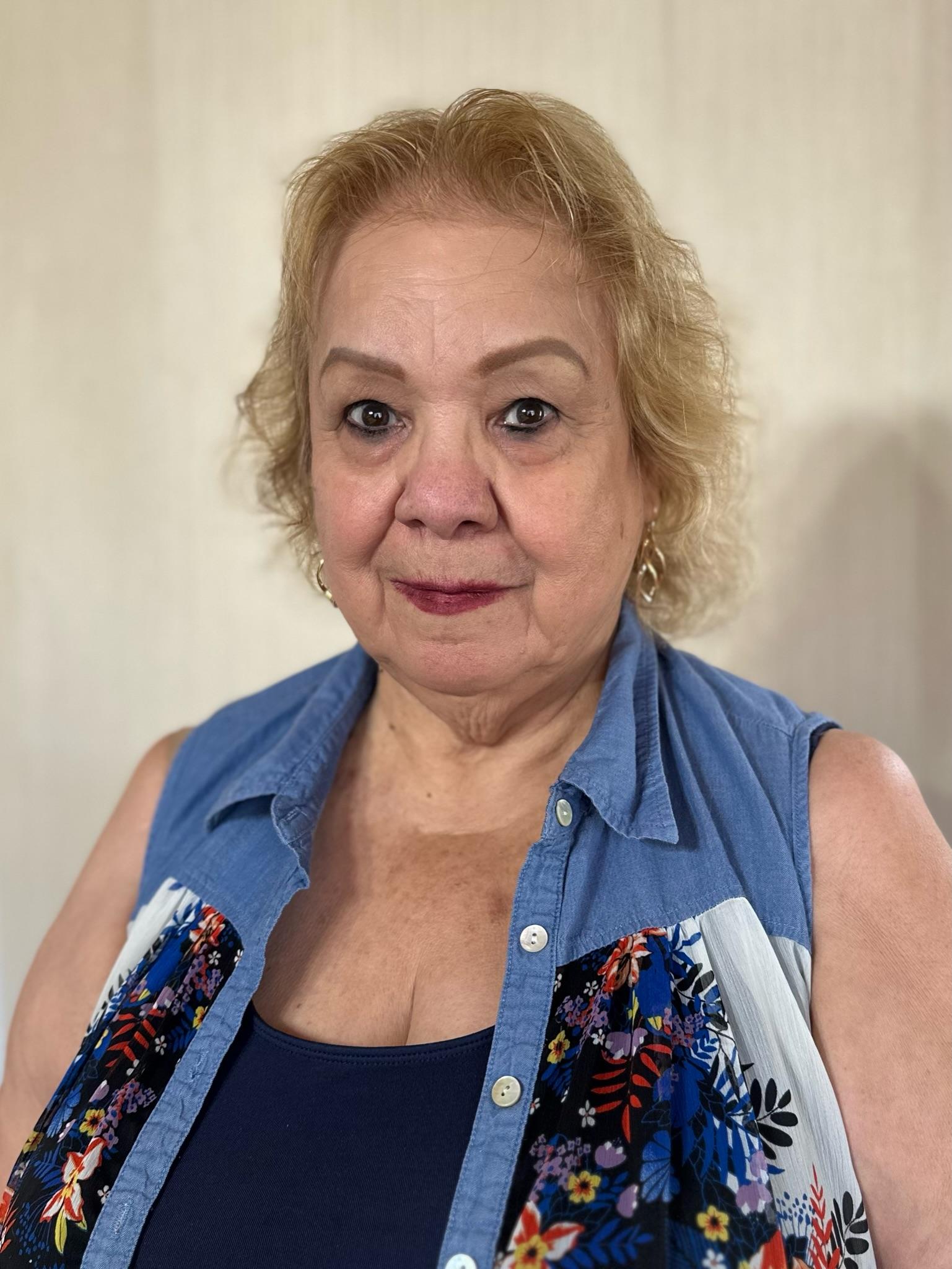
Lali Moheno
Organizations
MAYO, Colonias del Valle, United Farm Workers, Colegio Jacinto Treviño
Location
Edinburg, Texas
Biography
Born in La Villa, Texas, Lali Moheno grew up in a farm worker family. She became politicized at a young age when her father participated in a UFW melon strike in Rio Grande City. She worked with the UFW before beginning college at Pan American College. At Pan American, she became a member of the Mexican American Youth Organization (MAYO), which connected her to local political movements and groups. She was a key organizer of the Edcouch-Elsa High School walkouts, her alma mater, was an active member of Colonias del Valle, and was a founder of the alternative Chicano/a college, Colegio Jacinto Treviño.
Audio Clips
Interviewed by Jennifer R. Nájera on June 4, 2023 in Visalia, California
Moheno speaks about how her father depended on her to translate during the Rio Grande Valley melon strike.
J. Najera: Do you remember what years those were?
L. Moheno: Yes. It was way back in Rio Grande City, Starr County. I don't know. It's it's all over. That's how the UFW came about. They got involved eventually. They sent some people to work over here, over there. And I got to meet a lot of people. I was only like 14, 15 years old, but my father would take me a lot because of all... he, of everybody in the family. I was the one who talked a lot more. He said que no me callaba. [Laughter.] He said: "tu no te callas. Anadale, ven conmigo." Okay. So and also because I knew English, I, I learned English from a very early age, and Spanish. And to read it, I don't know why, you know, but, um, when I was in the third grade, my dad would make me read the Brownsville Herald, which was part of it, was in Spanish. And I would read it, yo se lo leía because he didn't know how to read English or Spanish. He didn't know. He later learned in adult school, but he didn't know at that time. So, I don't know how Ihe learned. I would read it out loud to him in Spanish, and then I would read my English, you know. So he said, okay, you know, both languages you're going to go because we're all on strike and all we want is $0.11 more an hour. What? Okay. So I had barely starting high school and I took. I was taking a civics class. Y yo me creia... I mean, I was, like, very interested in learning, you know? And in that class, while this was going on the strike and everything in the class, the teacher who was a white teacher said: "okay, you guys, we have an electoral system." What? "A voting." "Oh, I know. Because my mother votes. You know, my mother was born in Texas. My mother votes. Is that it? Yes." And then the teacher would tell us: "this is what happens when you vote. You know, you elect like Senator Bentsen. He got over there because of your vote. So when you guys are old enough to vote, you have to register and vote, okay.? So I got very influenced. Hmm. I didn't know that that we could get somebody in office. I know, y estaba muy chiquita. Okay. So then I went home and I told my mother: “Mother, I know why you're voting. Because you are electing the people over there in McAllen and in Edinburgh. Yes, Mother. See, I do.” You know, I was, like, fascinated with it. Okay, So then when Father told me: "Can you go with us at least listen para que me digas a mi lo que esta pasando." The UFW, y habian mandado gente. Cesar had sent people over and they were taking care of everything. I was just with the workers, you know, said: "okay, Father, yo voy con usted." So nos fuimos, and I was like… because the farmers and the UFW, they were negotiating him. Y me facino mucho the negotiating part. [You were allowed to visit?] Yeah. [Oh wow, okay] So I asked my papá, "Father, ¿cuando le digo que quieres $0.11 more?" He says: "pues, yo no se mija." Okay, I'm going to find out. I want to talk. I want to say something too, you know. Estaban muchos trabajadores. They were getting really ripped off. Todos. Okay. Yo, ya sabia porque andamos trabajando en las cebollas. And I don't know if you guys ever saw what happens when you do cebollas. It's horrible because we have to take it out of the ground, okay? And shake it, take all the dirt off, put it there, and then you just take it out, take it out. Then you have to come back and cut the root that's hanging in the bottom and cut the top, the green stuff. And that's how you get the whole cebolla. Yeah, we have to do that manually. You know, the workers. Okay, So we had to do all of that and they would only make like $0.10 a sack.
Moheno recalls presenting demands during the EdCouch-Elsa walkout and facing judgment from extended family members, who thought college was teaching her to defy gender norms.
L. Moheno: I'll show you a big article that came out and… and I did it and I would meet with them. It got very, very hot politically, and I wrote my own... After talking to everybody, the parents, the students, I wrote my own set of goals and demands. We used to call them demands, like that. Um, and I presented them to the school board, llena de miedo, Okay? My legs would shake because it was an all white school board male. Chocante de los peores, the school board members, all the schools had that, even in San Antonio, all over Texas. So we had to deal with people like that. Okay, and so, we boycotted the school and I was involved with it from the very, very beginning because of my brother and all the way till the end, it lasted a long time, about two years. We were able to get some help and another school that picked up some of the students, some of the students got reinstated and some did not get reinstated. But they've been very active, still, a lot of them. We just had the 50th anniversary of the walkout. Pan Am did it. UTRGW did it. Wonderful job. And what did I do? Oh, man, I just threw, up. I just dumped some of the books. Yeah, they're gone in the trash. Um, so you know that's how I started like that. De poquito, okay? De poquito, yes. So what happened here, te voy a decir algo that you need to know: my mother and her family, her brothers and sisters, started getting very uptight because I was a girl, and I was out there with a man, and I was not married. I could not, you know, at that time they didn't let us go out, all us girls.. You know, unless you were married, you know, and they were very...the men didn't want the women involved in anything. You had to be a housewife and no digas nada, you know, that type. And so my male uncles told my mother, "Ves, lo que paso? La mandaste al colegio. Vez lo que le paso? Mira como anda tu hija." And they used to pressure my mother a lot. My father el no me decia, he didn't care. My father was very nice. He was very nice with all my brothers and sisters. We loved him. But my mother was very strong. And my mother said, "Well, le voy a decir que no debe de andar alla con los hombres, pero ya se metio. No podemos sacarla ya, le dijo aunque yo no quiero, dijo, ella le anda ayudando Alfredo.. my brother, Fred, le anda ayudando Alfredo y sus hermanos." Y ellos mucho prescion. Then all the other women who were involved with us, there weren't very many of us involved for that reason was that the parents wouldn't let us be involved. They wouldn't let us out. We couldn't go out at night. Once you were home after school, you had to stay home. Ya no podian salir. So. But I broke all those rules. All of them. So then what happened, after que todos me regañaban,. okay?. Me regañaban los gringos or los gabachos. Whatever you want to call them. Me regañaban some of the older Latinos like "Ay, ya no digas cosa. Mira como nos miran. Mira lo que nos esta pasando." Ay, but I've got to say it, you know? Anyway, todos me regañaban, so it was very hard. So a lot of the women didn't want to get involved. Okay, so we broke those rules too, the women in the movement. Okay, so.
Moheno speaks about founding the Colegio Jacinto Treviño as a Chicano/a alternative to mainstream universities.
L. Moheno: Okay. The purpose... it was a very difficult thing to do. We found out. Okay. We thought that we could just start a school and find teachers to teach Chicano history,. you know, Chicano art, which we loved, Um, Chicano philosophies. We wanted to read Chicano novels from Dr. Galarza, you know, we wanted to read our own stuff that we were not allowed to read in other schools. And so that's what we thought, Oh, we'll start a school and we'll have our classes. Well, we clashed politically with the gabachos in Texas. They started fighting us and fighting us and fighting us. And we were like, we didn't expect that part, that very big political part. We did expect some hostility, but not that much. We got some big time hostility and so we had to fight all that. At the same time, we were trying to establish classes and trying to get accredited, you know, and that's how my husband got recruited. He got recruited. Well, they hired a center director and he applied. He was a professor at the University of Illinois, but he was very involved politically over there. And so we hired a very political person to come and help us, who was educated. My husband had two masters in education and all kinds of things. So he came in to help Narciso to get... try to help the school accredited. That's how that little book was given to us. We had to comply with a lot of that stuff, and we did. Antioch... no mas fijate todo lo que teniamos que ser. Antioch accredited us, but we had to comply. It wasn't like a lot of people thought, Oh, they're not studying, "no más estan haciendo lo que les da las ganas". No. We had to do a regular college. We had to take education classes, mathematics, community health, you know, political philosophy, whatever, art. We had to take art. It was the same, except that we had good people teaching us, not racists. That was the difference. We had wonderful teachers who actually liked us, you know? And so we love that part. Well, the more we develop the school, the more political hostility we got from the white community. The schools did not want us. And that's why we went all the way to Ohio, because nobody in Texas wanted to accredit us. Nobody. So then we were… we used to work very closely with the Crusade for Justice with the Tlatelolco school, Escuela Tlatelolco. And that's how we met Colegio La Tierra from here, from Berkeley and from Fresno State. We used to meet everybody down in Texas, everybody trying to do their own school. Okay. So it, you know, it was a very hard thing to do. We used to have a lot of internal discussions, very heavy meetings, very, very political meetings. We used to get infiltrated by police. They would send us Latinos, policias and create hostility among us. But we knew it. We knew we had them. A lot of us knew that. Okay, so we really had to be careful. We were afraid for our lives for a long time, all of us. But Narciso did a great job. He was a scholar. Very well read. He and, and then Victor was a scholar, so they used to send us, like Victor set up a whole seminar with Paulo Freire. Yes. And we went to Pablo Freire’s seminar. We went to Cuernavaca to study with Ilich. We went to New York to Brooklyn College to study under the same people who were doing the black schools. We went to Chicago to study. I went to the University of Massachusetts to Amherst to study. I mean, this was studying. It wasn't UT stuff. It was real.
J. Najera: So what did you feel like were some of the biggest lessons that you got out of going to all of those different places? What were the things that you all had in common, you know, in terms of ways of teaching.
L. Moheno: The students or the teachers?
J. Najera: What were you learning that was coming out?
L. Moheno: One of the biggest things was that we actually had Latinos who were big writers, and we actually had Latinos who were scholars. We would learn that because we didn't learn that in regular schools and we would learn that we were right about minimum wage. We were right about being working for equality. We learned that very well and that we were equal to everybody else. We never got into... we never had weapons. We were accused of having weapons. We didn't have any money. We were very poor students. We didn't . . . I didn't even have money to eat. I didn't have money when I was going to… to the university. I couldn't eat. I didn't have any money. I was just like and then, by then I had to work till 7 p.m... No food. Same thing at the college. And they used to accuse us of having guns, having drugs, having this, having that. No, ¿como? ¿de donde?.
Moheno describes a life-threatening experience when held at gunpoint by a local farmer because of her political involvement. She also reflects on completing her degree.
L. Moheno: They hated it. They still do in Texas. They hate the UFW, the farmers. Very, very much. Very much.
J. Najera: So do you think they pulled you over because of the union or because of the Colegio?
L. Moheno: Well, it was for everything because I was... people were afraid of us. I was involved with everything, with the union and with the Colegio. I was like, way ahead of a lot of people. They didn't like it that I knew that I was connected. And I don't really know why. I never asked anything. I did tell my dad, "Look, Dad, me asustaron con una carabina" [What did your dad say?] and my father said "pues, te dije que no anduvieras de noche." Y dije, "pues si, Dad, but we had a meeting and I had to be there, in a meeting." And there was, that was one of the reasons I had to go home because I couldn't sleep outside the home, because I wasn't married. "No menos dejaban." We had to go home, especially the girls, and the boys too, mis hermanos, we all had to be home, you know, so I had to go home every night from the Colegio y llegaba bien noche. Y mi papa was worried about it. Sometimes he would drive up to make sure I was coming. And ya. me miraba, ya se iba, you know. It was very hard, what I went through. And like I told you, I got very ill when I became involved with my husband. It was more or less a little bit,. he was already, well I didn't like him at the beginning. I really did not like my husband. He came into the Colegio and he brought in an educator. He didn't want us to be missing school. And I was the type that if anybody said anything, I was going to go picket at your office, and I would picket it, anybody. Si decias halgo bad about the Latinos, I'll be there with 50 people. I was there, picket at your office. We would picket at the courthouse and police stations. In this case, acababan de matar un muchacho la policia. Okay, we're going to picket you, until you get that policeman who killed our young man. He has to be arrested. So we're going to be there. So we started cutting class. Todos.
J. Najera: You started cutting class from the Colegio?
L. Moheno: From the Colegio! [Oh my God! Laughter.]. And that was a big no no because we used to get criticized. People thought we were not getting educated. Ves?But the real education, they thought was the real education. So I was out picketing. The administrators didn't like that. So Victor went to the picket line to see me. He said: “Listen, you've got 70 people here, 40 something from the Colegio.” And I said, "Yes, we're going to be here. I'm sorry, you're not going to tell us anything. We're going to be here all day, okay?" Y el: "No, no. Mira, Mira, Mira. You guys have to stay in school, go to the class, and then come and picket. I'm not here to tell you not to picket. I want you to picket. But don't miss school because you will have a better impact in your life and the life of others if you get your BAs and your MAs. And I was about to get my MA, you know, sSo I said, "I don't care. I don't want it. You know? It's just a paper. I don't want that paper, that certificate." And he says, "No, you do, you do want it." Uh, "No!" You know, so I used to fight him a lot. So finally some of the students said, okay, we'll go to class. I said, okay, “They want to go to school, then I'll go with them because they have to come back with me to picket. You know, we have to go picket offices.” And so um that's how I met him and that's why I didn't like him, because he wanted us to stay in school. And he ended up to be correct. We all got our education, all of us. I finished my master's in another school, you know, with all the different schools, I finished. And it was a big impact in my life economically. I make more money, you know, automatically, hasta me asuste because when I got my master's, my salary went up $1,000 a month. Era mucho diner que estaba ganando, you know, and I used to send a check to my dad. "Mira, Dad. Mira told el dinero que tengo." I thought it was a lot, you know, but,. that's how you know, that's... that's how we did.
Digital Archive
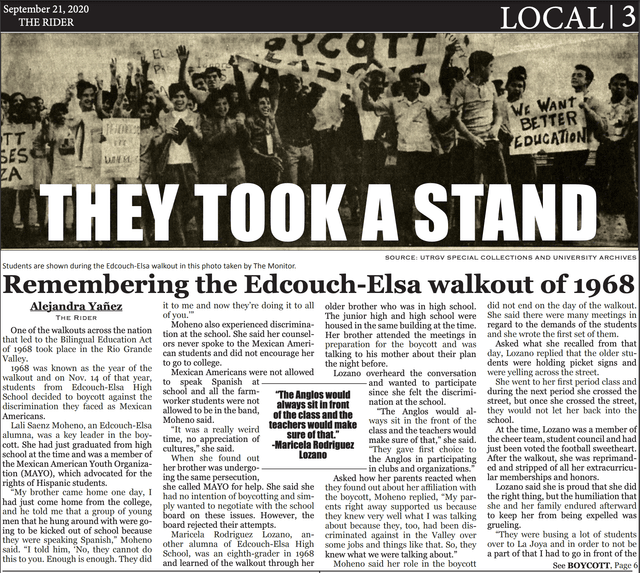
Lali Moheno and others remembered for 1968 Edcouch-Elsa walkout.
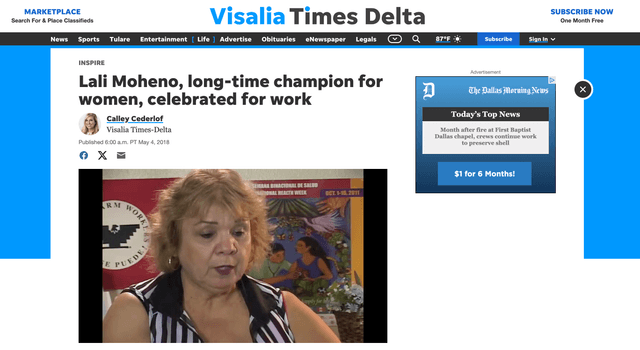
Moheno received Tulare County District Attorney's Office Justice Award in 2018.
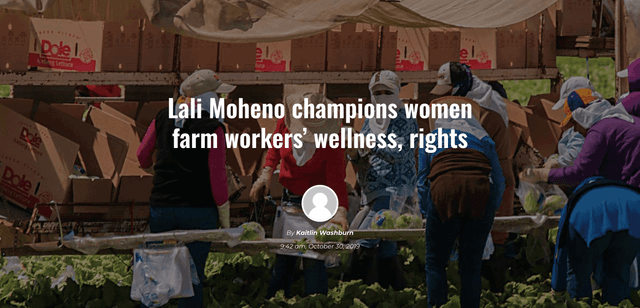
Sun Gazette article about Moheno’s Farmworker Women’s Conference on Health, Safety, Employment, Education and Environment.