Next page
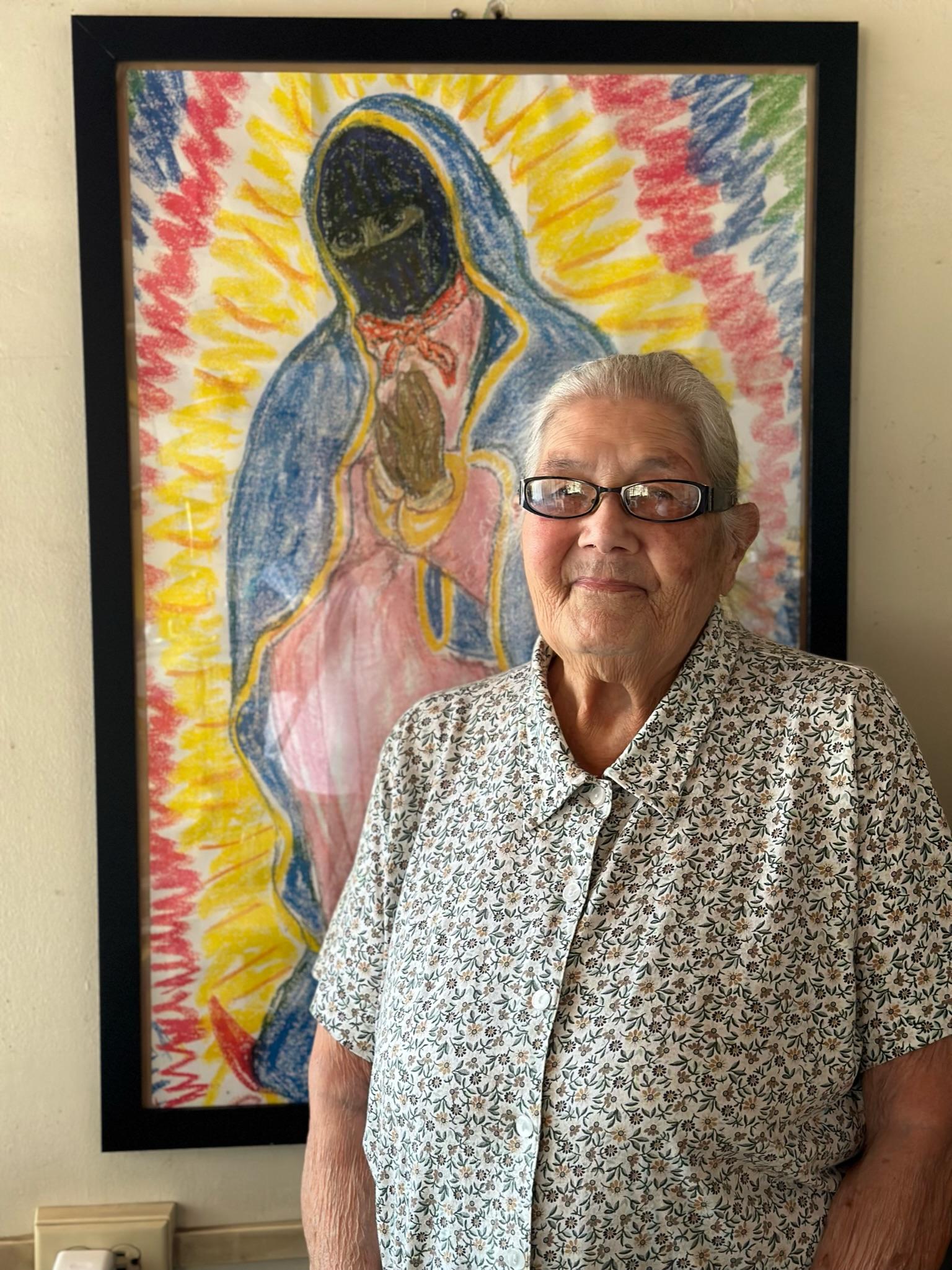
Raquel Rubio-Goldsmith
Organizations
Manzo Area Council; Coalición de Derechos Humanos; Pima Community College
Location
Tucson, Arizona
Biography
Raquel Rubio-Goldsmith was born and raised in Douglas, Arizona, on the Arizona-Sonora border. She studied law and philosophy at the National Autonomous University of Mexico and was a founding faculty member at Pima Community College in Tucson. Her early years were influenced by her mother’s education activism and her father’s labor activism. Rubio-Goldsmith’s areas of activism and academic research have included police brutality, immigration direct services, advocacy, education, and research. She has also worked in solidarity with the the Zapatistas in Chiapas, Mexico, including traveling to Chiapas to participate in the Zapatista constitutional convention. She was a critical member of the Manzo Area Council, and after it closed she became a founder of the Coalición de Derechos Humanos, which focuses on policy, especially regarding immigration enforcement.
Audio Clips
Interviewed by Jennifer Nájera on September 7, 2023 and October 25, 2023 in Tucson, Arizona
Rubio- Goldsmith reflects on the presence of Mexican nuns from la Compañía de Maria growing up in Douglas, Arizona. Though not part of her formal education, their dedication to educating girls made a positive impact on her early formation.
Raquel Rubio Goldsmith: But a really important part of my early education had to do with a group of Mexican nuns that had come into Douglas as refugees from the Mexican Civil War, the Los Cristeros. When Mexico started enforcing the Constitution in 1917 and really throwing the church out of the, that is bringing illegitimacy to the church, all these convents and churches and everything were closed down. And there was an order of nuns, La Compañìa de Maria, which were known for centuries in Mexico for their educating young girls. They had to close down their schools. They were throughout the central part of Mexico. Eran las escuelas las madres de la enseñanza, they were called, because they all had schools for girls. And so their novitiate was in Aguas Calientes. That's where the central part was. And they're still there. And so the novitiate decided that they had eight or nine young women who were starting out. And then a couple of the older women who were their mentors tried to bring them to the United States to save them from all the chaos and and be able to continue to follow their path to be nuns. So they ended up in Nuevo Laredo, but they could not get visas. The US was not giving visas to refugiados from the revolution. They didn't say it publicly, but that was what was going on. And especially... The Irish who had kind of taken charge of the Catholic Church in the US, were determined to show that they were more American than Americans, too. So they could integrate and be Americans because they hadn't been, right? This is 1910. It's not very long after the big, huge Irish migration, and they were Catholics and seen as inferior. And so the Irish Catholics took over the hierarchy over the years, and they really pushed to Americanize the Catholic Church. And so the last thing they wanted were Mexican nuns or priests coming over. So the nuns were there and they were running out of money. And the family in Douglas, a man by the name of Ignacio Gaitan, who had come there from Chihuahua, very Catholic, and someone, a friend or a relative told him about these nuns in Nuevo Laredo. So he said, "We will bring them." And he went to the bishop, the diocese of Tucson, which was the bishop for Douglas, and the bishop said, "No, we can't bring them because they have no money, and our diocese is very poor." This was in 1927. People were poor. It was before the depression, right, 1927, 1928? But anyway, he said, "No, we can't bring them." So then Ignatio Gaitan, with these other men said, "No, we will get the money. You don't have to support them. We, our community, will support these nuns." So he and his wife got all these women together, and they all pooled their money, and the family pooled their money, and they brought the nuns to Douglas. They rented a house. [Laughter] The only house they could afford that the the community group had rented was right next door to a brothel. [laughter] And so it's a very beautiful story of how these nuns settled into that house. And they planted a garden right away. They had no money. They were just living off the charity of these families, who were all working families. There wasn't any, quote, rich person behind it. And over a period of about, they immediately started teaching catechism to the children and these families. By the time I came to go to catechism, like around 1940 or whatever, they already had a house that had been donated to them by this wealthy Catholic Anglo. And, of course, the Mexican families continued to support them in their daily work. They they did all kinds of things. They would tutor children. They had a little nursery, a kindergarten kind of, which was called. The women, which es para domar a los niños para que crezcan bien educados. And so they would send their children there and then do catechism. So there were always more than 200 of us going to catechism lessons there. Con las madres mexicanas, right? And so that was a big influence on my life, because I started going there since I was about six, to make the first communion. And then these women were just incredible women. Madre Cabrera, I still can see her walking down Tenth Street, with... You never saw one of them alone, they were always two. Their habits and walking into town to buy whatever they had to do, whatever business. And they were always going to the Consulado Mexicano trying to arrange visas for young girls to bring and come and, bring the younger ones to be trained, whatever. And then in the '30s it became almost impossible because of the depression. But one of the nuns, the one who became the Madre Superiora there, was an incredible person. Madre Serrano. She was deaf, but she taught piano. She was a pianist.
Michelle Tellez: Wow.
Raquel Rubio Goldsmith: [Laughther] And I can remember my mother had saved money for my sister and me to have piano lessons. And I think it was to help for us, but also to help the nuns, right? And so my mother would save to send us. And at one point I hadn't practiced at all. And I thought, well, "She's deaf. She can't hear, you know." [Laughter] I went in and I started playing, and she was in the back of the room, and she came up and she slapped my hand, "Qué barbaridades estás haciendo, Raquel?" [laughter] I don't know how, but she was either watching, or the vibrations. Who knows what?
Michelle Tellez: Wow.
Raquel Rubio Goldsmith: So after that, I would practice all the time. [Laughter] But I got to...
Michelle Tellez: Wow.
Raquel Rubio Goldsmith: Love that nun. I saw her as this old, old, old lady, right? Because she was old. But to me, she was ancient. But she was probably about 60. She would teach us all kinds of things. And we had these special lessons so that we could train to teach catechism. And so they had special lessons for the older girls, and they had boys do first communion, but there were never any boys that stayed for the older things. It was always just girls. So it was this wonderful atmosphere for young women and a lot of laughter. And they had this beautiful garden. We learned how to plant flowers sometime, you know, all kinds of things. So that was a big influence on going to school. It wasn't in the schools, but it was an important part of my education there. And so they would teach, you know, of the great saints, great this, the great that, and a lot of the history of Mexico. But of course, from the point of view of a very conservative... Which when you're a kid, you just learn things, and they come in and stay and then later you remember and say, "Oh, that was so wrong." [laughter].
Rubio-Goldsmith talks about her time at UNAM, which provided a strong political and cultural education for her.
Raquel Rubio Goldsmith: Well, being a student in UNAM was a very political space. For example, one of the first things I learned... I had this early class, and so I'd be home every day by 2:00 in time to eat. And so one day I get to the school and there's this whole commotion going on. Se muere el día, se muere el día. Cómo que se muere el dia? No, no hay clases hoy. Porque something had happened politically somewhere. And the students were going to go to demonstrate. I mean, these are thousands of... But it's a few that are organized. And so they closed down. There was only one door to go into the university, and they closed it down so you couldn't go in. And I mean, what the hell is going on? I mean, "What do you mean, there's no classes?" And by this time I had a girlfriend, Araceli. And I say, "Qué paso?" "No pues que se muere el día pues no hay clases. La policia. Vamonos." So I went home. I get home at 10:00 in the morning and my aunt says, "Qué haces aquí, qué paso? Pues que salió el día porque quién sabe ya empezaron esos terribles esos bolcheviques."
Michelle Tellez: [laughter] Bolcheviques
Raquel Rubio Goldsmith: No, yo le dije Aida. That's my other aunt, which was also her niece. Right? Ya le dije Aida que eso de mandársela a la universidad me va bien, tenemos que llevarte a la al iberoamericana o one of the private schools. And me, I heard that and I thought, "My God, that's not what I want." I thought, "Monjas!" You know, I had had monjas. I didn't want monjas in my life now. [laughter] I was out of that. I wanted to go to UNAM. And so when you know, no hay problema it's very simple. Porque ya pagamos la colegiatura, tut tut tut. Pues sí vamos a ver, pues a ver qué pasa. Well, but that meant was every time que se murío el día I didn't go home, I waited until the right time to go home. Right. And Araceli the same way. And then we had another friend, Barcero, Maria Barcero. So the three of us, they would take me, que yo no conocía a los museos, a las iglesias. We would stay downtown. So I got to know the downtown so well, so well, because there were a lot of días que se moría [laugher] entonces. And then there was a movie house at El Prado Hotel, which is no longer there. The hotel is gone. Pero at 11:00 in the morning they'd open and they had French movies. So sometimes we'd go to see the French movies. So it was like my cultural education, right? You had the university education, and then the education of the city and all that. So that that really meant a lot. And part of that was political. There was a lot of politics in the school. So they had elections for El Presidente de la Asociación de Estudiantes, and they would campaign in El Partido Verde y El Partido Azul. And here you have... The guys all wore coat and ties. We all wore stockings. It was a very formal way of dressing. Ahi anda todo el mundo haciendo campaña, que los verdes que los azules. Que quién sabe qué? Y luego viene la elección en el salón muy elegante. The two boxes. And you had your little ballot and you walk up. Well, the guys that were running for president, they stand by their box so they could tell [gasp] who voted for who. [laughter] There was no secret vote.
Michelle Tellez: Wow.
Raquel Rubio Goldsmith: So when I saw that, I walked out. I said, "I'm not voting this way. This is all wrong." So then some of the other girls, because there weren't that many girls in our class. We were in groups. And so there would be like 70 of us and of the 70 there were maybe ten girls. So we hung out together pretty much. We decided that the next year we were going to have a candidate to run for presidente de la Asociación Estudiantes. So that meant we had to go to all the meetings of La Asociación and start... Well, we'd go with all these guys. Carlos Monsivais was one of them. As a matter of fact, he was a real. [laughter]
Michelle Tellez: [inaudible].
Raquel Rubio Goldsmith: Well, he was a disaster, I hate to say, okay, real disaster. But anyway, we went and they were upset, because like we were kind of showing up. And so we weren't able to get a woman candidate. They're just there just was no support. There were too few of us. And although we went to girls in other class y todo. So you start getting a political education quickly..
Manzo area council launched a community policing program in the 1970s to combat police brutality.
Raquel Rubio Goldsmith: So we called for a big community meeting to deal with the issue of police brutality. And we had like 400 or 500 people show up that night. It was amazing because people were really upset, and we had a number of people that had come that were from the hilly part, too. So it was a very integrated group. Well, we just went to town. We set up a series of meetings with the... First we went to the city council, we went to a meeting there, protested, had a rally, and then set up a series of meetings with the Tucson manager. Because the manager, we had a city manager, they're the ones that really run everything. And it was a Mexican American, Joel Valdez, who didn't like radicals. But, he also was a Mexican American. And of course, he was not in favor of police brutality. So we started a series of meetings with him. We had representatives from our neighborhood, from the barrio and the other place. Maybe about ten people and Margo organizing with them, preparing meetings and going. And we ended up with an agreement that the city would pay the salary of ten... no. What was it?... Eight policemen for a period of six weeks, where they would have intensive Spanish training for five weeks and one week of cultural training. And we brought up two specialized teachers from Cuernavaca, who taught us Spanish as a second language with all the new methodology. We brought them up, and then Lupe and I would teach the cultural week. And we would teach Chicano history and take them to meet families in the community. So they approved it, and that was going to take place for five years. We would have three groups a year for five years to train all the policemen. And so we started out doing that and it was working really quite well. They set up community policing, an office out of one of the malls right in the barrio. The policemen started knowing everybody, all the families, you know, all that. And it went really well. However, of course, this was costing the city money because they were paying the full salary to those people taking that. And then we had to pay the salaries of the teachers, and they lived with families. They didn't get per diem, they got a salary. And then, Lupe and I didn't get paid. But even then, what would happen is these police would get trained, and they were getting hired by other cities right away.
Jennifer Nájera: Oh, no. [Laughter]
Raquel Rubio Goldsmith: So we trained. And before we knew it, half of them were gone. But it was a very successful program. It really helped and it made a difference in what went on then. Because police brutality was a real problem. And so it helped, and so it gave us a lot of good energy and it gave us a good reputation. We had really accomplished something that went beyond the barrio.
In 1976, the police and Border Patrol raided Manzo’s office. Manzo sued the Border Patrol, raising money and national awareness for their organization.
Raquel Rubio Goldsmith: But our immigration project was just growing and growing. So in April '76, our little office, our office was about the size of this room, the police and the Border Patrol came. Raided. They took everything we had. All the posters on the walls, all our files. We had 500 families that we were doing immigration work for. They took all the files, and that night they deported more than half of those people.
Jennifer Nájera: Oh my God.
Raquel Rubio Goldsmith: It was horrible. Just absolutely horrible. And then they accused Margo of three felonies of evading an undocumented, driving an alien. She had driven a young woman who was pregnant to have her baby. She had driven her to the hospital, and they said that that was a felony for driving an alien. So they came up with charges. Margo, and then we had two nuns who worked there as volunteers, and they also were charged with felony counts. These were federal felony counts for breaking the immigration laws.
Jennifer Nájera: This was in '76.
Raquel Rubio Goldsmith: Seventy-six. So, now that I look back on it, they did us a great favor. Because, number one, the Border Patrol was so disorganized, they took those files and they deported just about all the people involved. But then later, they didn't even know who they had deported. They couldn't find any of the records. So we sued them. They had charges against our director and stuff, but then we sued them for damages and all those things. Of breaking the rights of all these people for their files and confidentiality, all that stuff, but in a great big lawsuit. And so to do that, we had to raise money. We had to go give talks. We went all over the country, we connected with all these immigrant rights organizations throughout the US, raising money. And we raised a lot of money for our defense funds. We got to meet people all over the country, set up networks, all of that because of what they did. And then we had some really good lawyers helping us deal with the issue here. The good thing about the lawyers was that they helped us put forth a lawsuit against the Border Patrol, and they kind of kept those criminal charges at bay, kind of delay tactics. In the meantime, we were doing lobbying in Washington all the time. Now, this was during the Carter administration, and he had a Chicano as head of the immigration. Castillo, I think, was his name. So we send up people up to Washington. We went up to Washington. I mean, for three years it was like this intense campaign. And we finally got the charges dropped in '79, I guess, right before Carter was thrown out of office.
Rubio-Goldsmith arrives in San Cristobal as an observer from the United States Chicano delegation to la Conferencia Constitutive of the Zapatistas in Chiapas, Mexico.
Raquel Rubio Goldsmith: So we met there. And then I left my bags with a friend, and my suitcase with a friend there in Madison and took a plane to Mexico City and then a plane to Tapachula. And then got to San Cristobal in a taxi, and joined 4,000 other people that were coming to the encuentro constitutional. We all had to be checked. We had, you know, all the security kinds of things. There were lines here, all over San Cristobal there were lines. People showing their credentials. It was just so exciting, because there were people from all over the world that were invited as delegates. And then there were all the Mexicano delegates, right? And so they had two days of sessions in San Cristobal to prepare for going into the jungle, to Oventic. And I went to the workshop that was on the writing of the new constitution. There were different workshops. One was for how to organize the government, you know, different ones. But I went to that one and Lynne Stevens, the anthropologist, was there. We sat together. It was being held in a ring for cockfights. [Laughter] And it's all cement bottom. And it kind of has a peculiar kind of smell [laughter] and aroma. So we started like at eight in the morning, and we were supposed to finish at four in the afternoon. To turn in our report, right? It was filled with Mexicanos, of course, that were there with all their propositions for a new constitution. And so there were young people. There were farmers, young campesinos, workers. Not very many women. And so they started, they made their list, of everybody would get, like they said at first, five minutes. Then they lowered it to two minutes because there were so many speakers, each one going up and presenting a resolution of what they wanted in the Constitution. And there was this one very old man, tall and thin, with his sombrero, wearing the white peasant, the campesino dress. But it wasn't like a costume for him. It was what he wore all the time. And he came up and he read, he didn't read, he recited this poem. He put his resolution into a poem. It was the most amazing thing I had ever heard. The way he talked about their right to the land, and to have their land. Not to own it, but to share it and to have it. It was just beautiful. And so everyone was a surprise, that went up to talk. So of course we didn't finish by 4:00. We were there, it was 9:00 at night and we were still going. But there was this fervor with all the people there. I mean, this thing, we're going to change the world. It's really going to happen. And just beautiful.
In 1994, Raquel Rubio-Goldsmith attended la Conferencia Constitutiva of the Zapatistas in Oventic, Chiapas, Mexico, and it was unfortunately rained out.
Raquel Rubio Goldsmith: So at about 6:00, it's starting. We're all starting to sit down and they had folding chairs up in front, like they got me a folding chair. And there we are, in Marcos comes and all this brilliant stuff, and they're playing music, and it's just this wonderful feeling. I mean, here were like 4000 people all together, happy, ready to move forward into a new world, right? And the speeches start, and they have their speech, and another speech, and another speech. And suddenly in one moment, the sky opened and every bit of rain that could be possible came down. The wind, the thunder, the lightning.
Cristina Salinas: Oh, wow.
Raquel Rubio Goldsmith: The tents were blowing over, the lights all went out so you couldn't see anything. It was totally, totally dark, and raining, and immediately the mud... And so I'm standing and I said, "What am I going to do?" I stood up and somebody grabbed me and said, "Venga, Raquel," I didn't know who it was, and took me to the tent. So one of the people that I knew took me to my tent. So I opened the zipper and I get in. It's a little two person tent, you know, that. They have the canvas on the bottom for the floor, and then you zip it up. So I'm sitting there on top of my backpack. And then this fellow shows up. I guess it was his tent. This guy comes in and we put up the zipper, and it just is pouring, pouring, pouring. And you hear people outside yelling and trying to find each other. So we're in our little tent. And then it keeps raining, it doesn't stop. The water starts coming inside. I thought, "Oh. So if I stay in here, I'm going to drown." [Laughter] I mean, just like because I kept getting higher and I had picked up my backpack and I was holding it up, and the other guy said, "I think we'd better get out." And I said, "Yeah, I think we'd better get out." [Laughter] So he lowered the zipper and you look out, you can't see anything. There's just all this water coming down. And I'm standing there and I walk out. The other guy walks out and goes somewhere, and I'm just standing there saying, "Well, I'll just stand here. It's going to stop at some point, right?" And then suddenly, a Zapatista soldier has a little light. He comes up to me, "Señora, venga." He takes me by the arm. And by then it was stopping raining, but it was still real, real dark. And I could see up a little hill right up ahead, a big bonfire. And so he walked me up there. And there must have been maybe 50 or 60 people up there, all in the circle. Sitting on the mud, sitting on rocks, standing around the bonfire. And it stopped raining. And so I came and somebody gave me a rock. I sat on a rock. And then people started talking. The rain had stopped and it was everybody kind of... Somebody started it, "Pues yo soy de la Huasteca y vine porque aquí vamos a cambiar el mundo. En mi tierra." And they would start saying the conditions of the pueblo and why they had come. One person started that and then it went on. Everybody around started telling their story.
Digital Archive
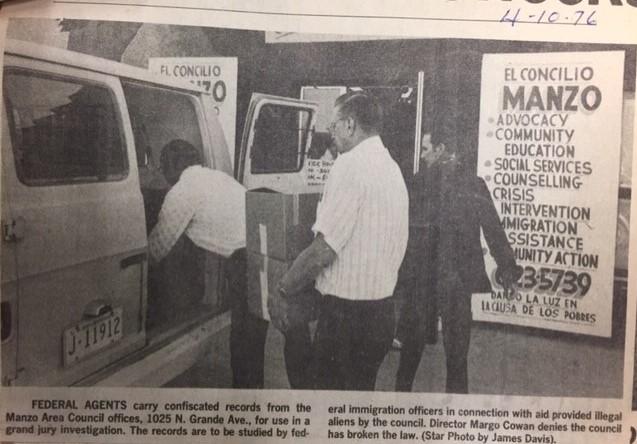
News clipping of federal agents raiding the Manzo Area Council office, 1976.
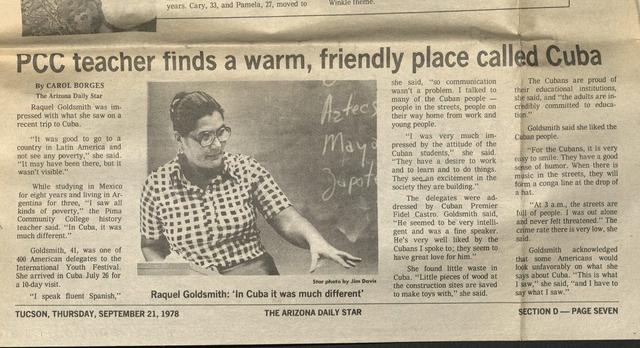
News article featuring Rubio-Goldsmith regarding her educational visit to Cuba.
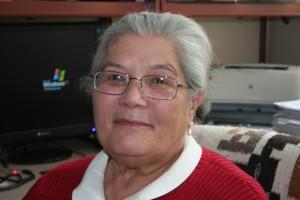
Rubio-Goldsmith in her office, circa 1990.
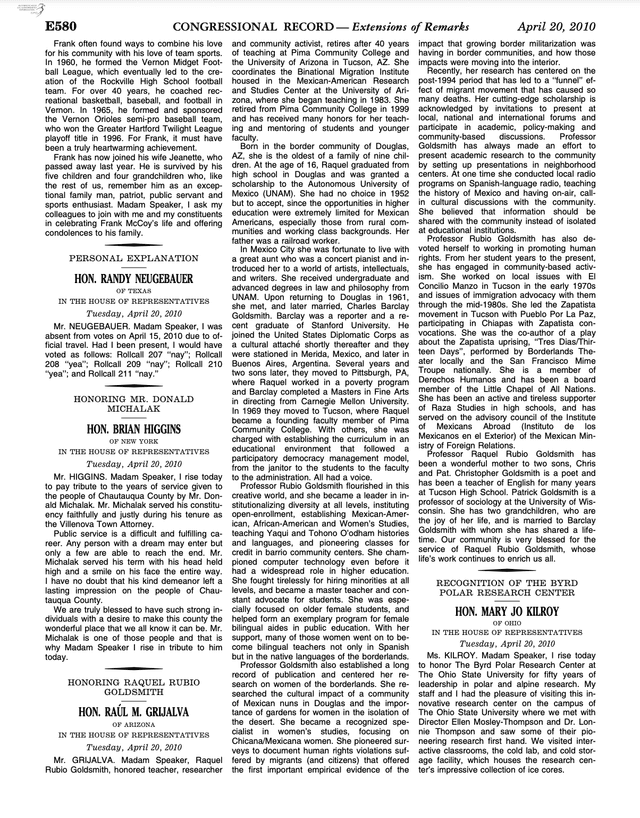
Text of Arizona Congressional Record where Rubio-Goldsmith is recognized for her service to the Tucson community by the Honorable Raúl Grijalva.
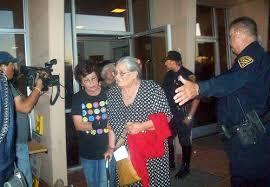
HB 2281 leaving hearing for TUSD School Board meeting discussions; community trying to push the board to go against state meeting; police presence.