Next page
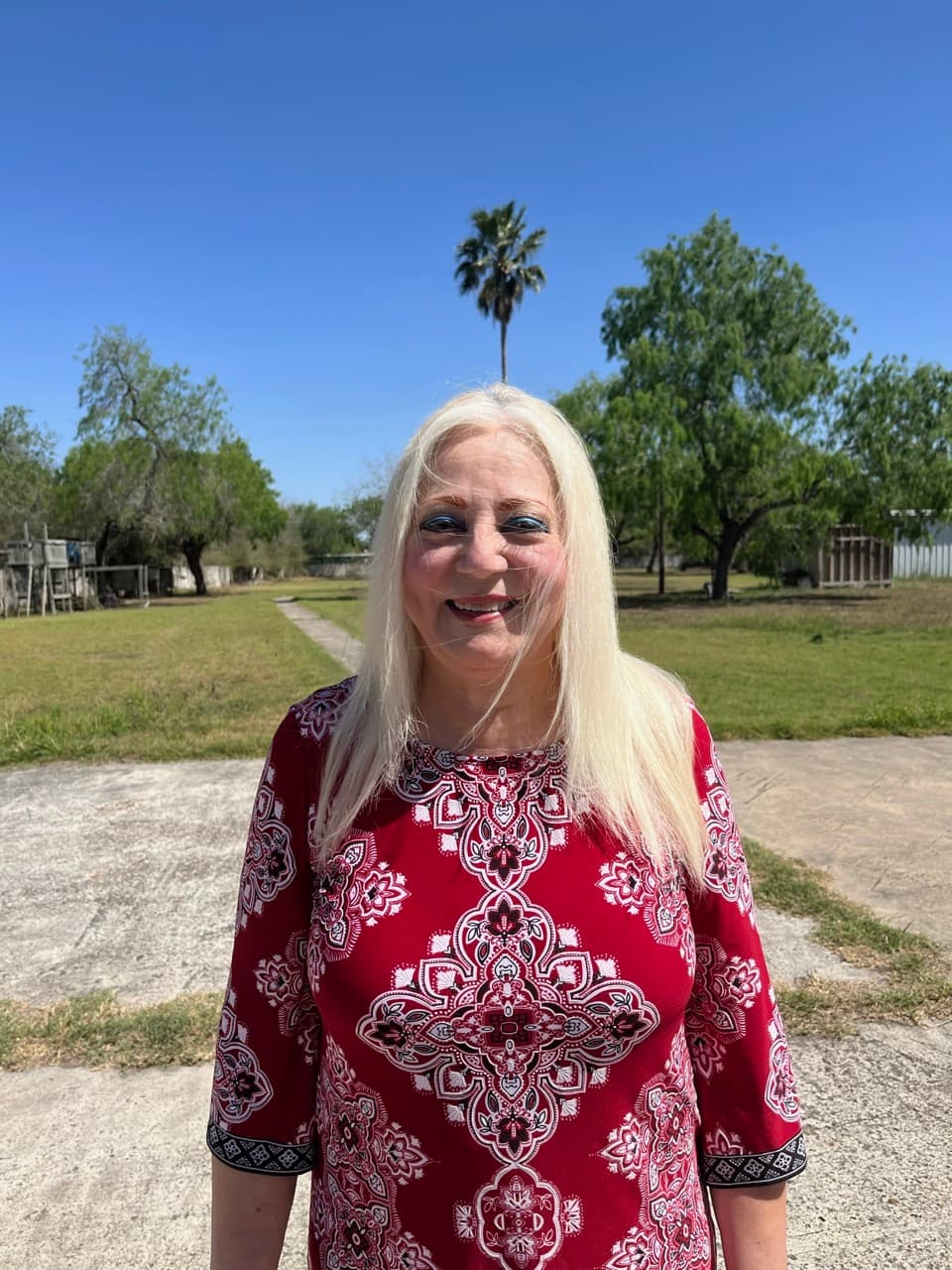
Sylvia Handy
Organizations
Hidalgo County Commissioner, Donna ISD Trustee
Location
Donna, Texas
Biography
Sylvia Handy grew up in Donna, Texas. Her parents advocated for her education from a young age, and her father fought for her to attend a local school rather than the designated Mexican school. Her parents also served as political role models: her father was elected city commissioner in Donna, and her mother was a “politiquera.” Handy attended Pan American College (now UT-RGV) prior to apprenticing with an attorney, and she later became a court coordinator. She served as an officer on the Donna ISD School Board and later became the first Latina County Commissioner in Hidalgo County.
Audio Clips
Interviewed by Cristina Salinas on March 4, 2023 in Weslaco, Texas
Sylvia Handy discusses the emergence of racial consciousness as a child when she became aware of the inequities of the local school system.
Sylvia Handy: Yeah, I grew up in Donna. I went to the primary schools there and graduated from high school there. Um, when I went to school about three blocks down from my house was a primary school because back then they used to have two primary, junior high, and high school. I think they call them differently now. But I remember my father taking me in to register me to go to kindergarten. And I remember that the secretary there told my dad, Mr. Handy, you need to take her to the other school. And my dad's like, What other school? She says, you know, the other school, the one that's across the tracks. And my dad says, Why am I going to take her across town when there's a school here? Is there something wrong with this school? And she was like, No, but this is for the. You know, for them Mexican kids. You should put your daughter over there in the other school. So right there, I think that and my dad was furious and he said, no, we live three blocks from here and she's going to go to school here unless you tell me that there's something wrong with it. And so I think at that early age, I started, um, learning about, you know, prejudice and, you know, biases and those kind of things at a very young age. And I also remember because of my last name being handy, that I was always the teacher's pet. I always got, you know, picked for something when I knew I shouldn't be, you know. And I remember thinking, well, why doesn't my friend so-and-so get this? I mean, she is, you know, smarter than I am or she knows more than I do. And but, you know, that's where I first started seeing, you know, those kind of situations. And at a very young age.
Handy discusses growing up in a political household and reveals the emergence of the term ‘politiquera.’
Sylvia Handy: Actually, my mom did. My mom was a seamstress at a company here in Weslaco called Williamson and Dickey Plant. And they would sew men's or just I guess sewo work pants. And she used to work there. And there was a lot of the ladies that worked in those days worked at those plants. I think there was one in Weslaco and one in McAllen. There might have been one in Edinburg as well, but a lot of them, a great majority of women worked in that there were seamstresses and so they had all this, you know, I remember her talking about getting together with some of the ladies here from Weslaco and trying to get them all registered and getting them out to vote. And so I think that back then, that's how they started coining them Las politiqueras because they were they would get involved in politics. And I feel sad right now when they talk about the politiqueras in a bad way because, you know, that's not the way it started. Politiqueracs, to me is an election worker. You know, just because it's a name in Spanish doesn't make it a bad thing. It describes what it is. It's an election worker. And so, yeah, they got very involved in helping their husbands or their brothers, you know, to get people registered. So and not just registered, get them out to vote. Yeah.
Cristina Salinas: So she did that. She would register people to vote and then she would remind them and sort of motivate.
Sylvia Handy: People, motivate people and talk about their problems. You know, they would ask them, you know, what do you see as a problem? They always knew what the problems were. I guess they would talk about it during their lunch hours. You know, they would discuss problems. And these women were very instrumental in letting them know, look, there's a problem here and something needs to be done and who's going to do it or how can we do it or, you know, and I think it was the start of something big.
Cristina Salinas: And did she ever talk to you about that? I mean, how did you know she would.
Sylvia Handy: She would discuss it with my dad at dinner. Because we would always have dinner in the evening. It was traditional for us to have dinner in the evening and my dad would be sitting at, you know, at the head of the table and my mom would be, you know, putting the food on the table and telling my dad, oh, you know, I heard this today at work, you know, so so-and-so is having trouble with someone or, you know, there was a problem, there was a wreck over here because of the road conditions or there was not enough light or there was always some story, you know, every day of something happening. And her telling my dad, what can they do or who can they go to or, you know, and my dad would tell her, you know what to what to, you know, what to tell him to do or where to go. Yeah.
Handy remembers and describes the moment she was elected as a County Commissioner.
Sylvia Handy: And so I thought, “Okay, I have one month to try to do something here and what am I going to do?” So I relied on my dad and I relied on friends. And then I went to my first forum and I thought, okay, I'm going to see my competition at this forum. So there were the seven of us, including the commissioner and who, by the way, got acquitted. And so we went to this forum and we all, you know, made our speeches and we all answered questions. And I remember scoping out my competition and I'm thinking, okay, I don't think the majority of people know what they're talking about or what their plan, they don't really have a plan. So I knew that I had two people that I need to, that was going to be my competition. And there was a young man there actually, he was from Edcouch, or I think he was a mayor in Edcouch, spoke perfect Spanish and perfect English, and did really well in his speech. And I thought, “Wow, you know, he's good.” And then, of course, the commissioner, who was the commissioner, he was very knowledgeable. And of course, he knew what was going on. And so I went up and I did my speech and all that, and I ended up getting a standing ovation. And I thought, “Okay, I guess I'm I guess I'm going to be all right.” So that kind of…
Cristina Salinas: Do you remember what you talked about in your speech?
Sylvia Handy: I remember talking about what I had seen with the schoolchildren and what Donna was going through, that I was on the school board and that my the reason I was running was because, you know, somebody needed to do something. And I said, “Here we are going into the 21st century and there's people that don't have potable water and there's people that are still using outhouses. Why is that still happening now? Why hasn't anything been done? Do you all even know that this is going on?” And the majority of people were shaking their heads. “No, we didn't know that was going on.” I said, “I didn't either. But I'm here to tell you that it is. And people are suffering.” And so, wow. I mean, that was just, you know, very impactful. And so that was the start. And then I was in a runoff with a commissioner. And I remember when we were in the runoff, I remember that that's when he got acquitted. And I thought to myself, “You know what? I'm not going to really work the runoff because I really want him to stay on. As a commissioner because he's got experience and I have none.” And I thought he's probably the best person to stay in. So I didn't really go out and campaign on the, for the runoff. I just kind of, I was there. I would go to the events and all that, but I didn't really, really try as hard. And I was surprised that I won and I won with very little votes. I think it was like maybe 75 votes that got me over. And I wasn't even here because I had gone to a school board seminar and I was out of town. And I remember telling the elections clerk back then, “Hey, when you do the,” because he had asked for a recount. And I said, “Hey, when you do the recount, can you let me know so I can be here?” I said, “Because I'm supposed to be going to a seminar.” And he said, “Yeah, I'll let you know.” Well, no, they did the recount while I was out of town. And I thought, “Well, that wasn't very fair for them to do that, especially when I had told him, ‘don't have it while I'm gone, let me know.’” So as I was coming home, I got to the airport and my supporters were all there with balloons and everything. And I walked down, walked out, and they were all cheering and… And, “Congratulations,” and all this. And I didn't know what was going on. And, “We won. We won the recount. You're going to be the next county commissioner.” And I was like, “Wow.” I couldn't believe they had done that without me being here. But, you know, it happened. [What year was that?] That was in 1996. So I took office my first year in 1997. So. Yeah.
Digital Archive
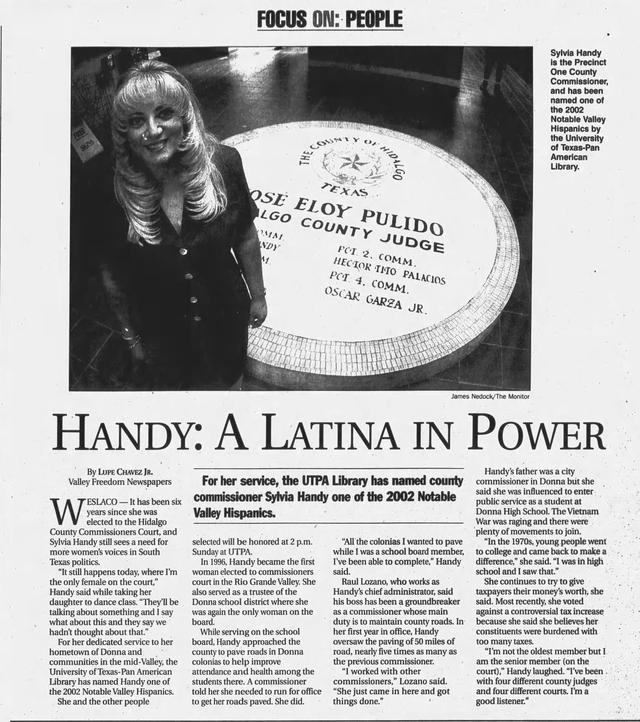
Handy was featured in 2002 for her service on the Hidalgo County Commissioners Court. From The Monitor, October 9, 2002.

Sylvia Handy’s request to raise pay for road crew is rejected. Article from The Monitor, March 5, 1999.