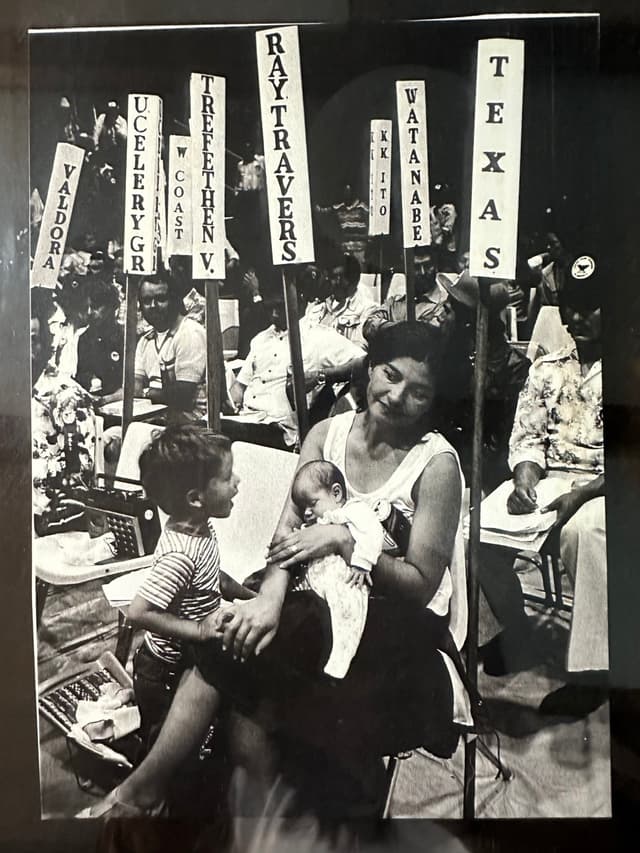
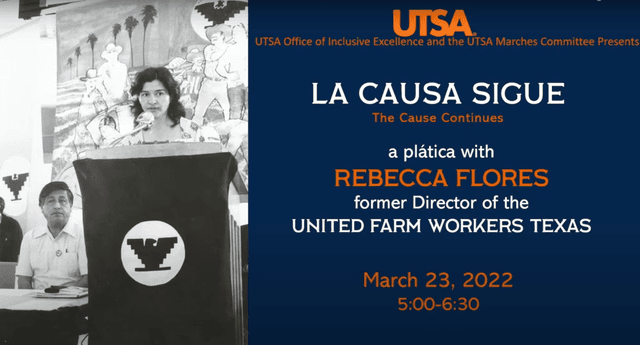
Rebecca Flores: Well, anyway, because people work day-to-day, and they live day-to-day, right? What I earned today is what I feed my kids with tomorrow. That kind of stuff. So anyway it's a hard decision to force people to make. I really think so. I think strikes are the last thing you want to do with people, unless you have a lot of money saved up for it. So when Fred came into town... It was myself and six farm workers who had just left the fields the day before. And so with us, we organized the first... Between March of '78 until January of '79, with a summer off because everybody had left town. We had house meetings every day to the point where, in 1979, which is that picture of me and my... No, no, I'm sorry, that's not it.
In the January of 1979, we had our first UFW convention at the Pharr gymnasium, the Pharr High School gymnasium. You remember that? It was like, it was a round... The kids used to call it the bronc. And we had a thousand delegates. It was the first convention of farm workers in the history of Texas. The first. With a thousand delegates. And these were people who had been elected by their committee to come and represent them. So the whole thing was really educational for everybody, right? Is how do you get there? How do you get from a committee of farm workers in the colonia . . .
Because we went after colonias. We organized colonias, because that's where farm workers lived. Because that was where the poorest housing was available. So they lived there, which is a really easy setup for us, more or less, right? Because we knew where they lived. And this is the trajectory. Okay? So farm workers would come into the union hall and they would say, "Rebecca, I need some help with this. Fill out this form, food stamp form, fill out this whatever." And so I would, and then I would ask them, "Can I have a meeting in your house?" And I said, "It's just going to be a small meeting. You just invite people who you know. Don't invite any strangers, people who you trust. And they have to be farm workers, of course."
And so that's what they did. So then we would have no more than eight, ten people at the meeting, adults. And then we'd have all the children, right? But we'd have more. And so we would all sit at the kitchen table, and I would take... What do they call it? Print paper? You know, the rolls of paper that newspapers have. Because we had a couple of newspapers there, and they would give me these rolls. And we would cut them off, roll them up, take markers, we would roll tape on the markers, we take two markers. I mean everything we did was economical because we did not have money.
And so we would go to this house in the colonia, and we would put the paper up on the wall, and we would say, "Okay." The first agenda for the first meeting was to get people to talk. We'd say, "Okay, what are the problems you have in the fields?" And the first meeting that I had, I remember with Lalo Abaitua and his family and the neighbors, Lalo says to me, "Rebecca, we don't have problems." And I was like, "Oh my God, where do I go?" And let me say that this is an honest answer, right? Because at that point, when I was working in the fields, I didn't have any problems, right?
I mean, they paid me. I didn't know where it went. My father got it. It was like something that we were supposed to do, right? Because when you're poor, you do what you're supposed to do. You don't ask any questions. So Lalo says, "No tenemos problemas, Rebecca." "Y ahí, señor." So then I started asking him, "Oiga, pero cómo sueldos?" Digo, "Así no nos paga nada." So it started like that, right? Then they began to understand that this was their stuff, right? "What is going on here with you?"
And then they talked about the contratistas. How the contratistas would keep... They would pay them in cash, and they never knew really how much they should have made. They would pay them in a little envelope with the cash like that, and then they'd say, "El seguro social lo turbabas," verdad? Pero they never knew if that money went to Social Security. So they never had a fund. That was how awful it was, is that these workers who obviously were going to get hurt, or age out, or whatever. In the end of all that time of hard work, they were not going to get one penny from Social Security. Because nothing had been paid into it. So then there was that.
So they started... I kind of like looking at all of that. And then they started talking about the accidents that they had in the fields. And I said, "No, esto pasó, es lo que pasó, que." I remember that one man, he had broken... He had fallen, he was picking oranges off of a ladder. He broke his arm and he came to the Union Hall. And he said to me that what they did to him was they sent him to Mexico with $50. "You take care of it." That's what the grower did. That was the insurance.
Rebecca Flores: And so people started talking about accidents. Then they started talking about... The women started talking about toilets in the fields, because that was their big deal. Women have always talked about that. Es que no, porque cuando se pone, when they had their period they never knew what to do. And they said they would make circles in the fields, because onions are flat, right? There's nothing to hide behind. So they would make circles in the fields like that, protecting themselves, and would open up their skirts. And they would do that. And they were always mortified about that. So that was the thing they want, they were talking about all the time, was toilets.
So we began to develop from their conversations. And everything that they told us, we didn't care what it was. And that's what Fred told us. He said, "The minute you tell somebody, 'No, eso no es... That doesn't go with what we're talking about,' you shut that person up. And they won't say one more word." He says, "Don't ever do that. Everything that they say you put upon the... You write it up. Because it's important. It was important to them." And so what happened was that women started talking. And so we saw the development of women because they started seeing that what they said mattered.
The other thing was that I had just had babies, and so I would haul them with me. That was the other thing that I think taught women that they could... If they were having babies, too, they could be part of it. And so I remember I would put Sara, because she was little at that time, up on the kitchen table. Because we had these horrible little seats...Talk about... No safety at all. Ahí estaba la huerca. And so everybody had their babies and stuff. And so the women started saying, "Well, you know what? If Rebecca can do it, I can do it too." And they kind of started convincing their husbands, their partners, their husbands generally, that having children should not keep them, from doing anything.
So there was a lot of things that I think happened that were good. Because if you notice... Now, probably better than it used to be. But also, men were like workers. But in California, you really had a more male leadership than in Texas. In Texas, we've always had female leadership. In California, you had Cesar, you had all those guys. All the board really was male, except for Dolores, when you look at it. And so you had that. Although probably a lot of women worked, but they didn't get into the leadership stuff.