Next page
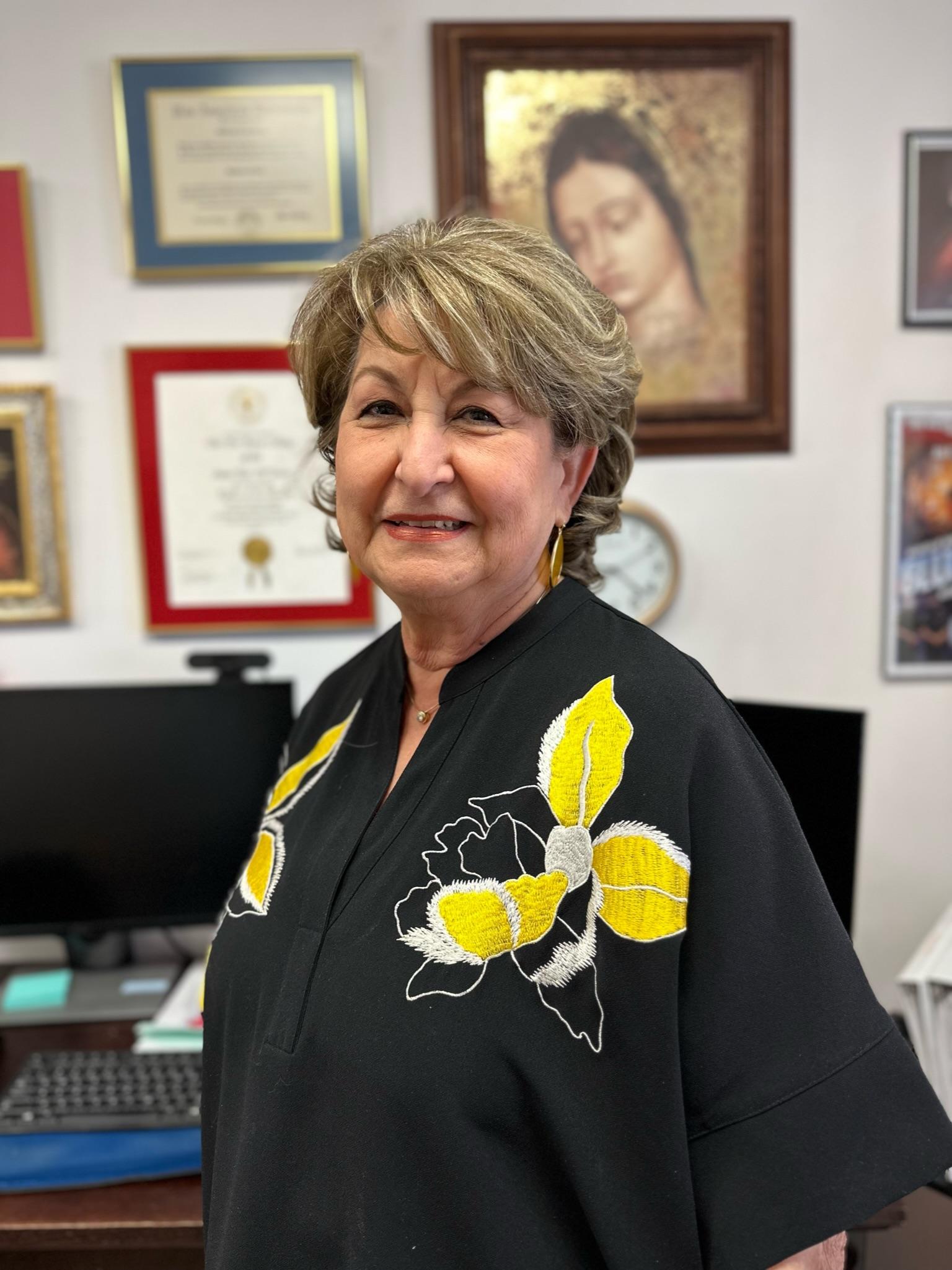
Ofelia de los Santos
Organizations
Valley Interfaith
Location
Edinburg, Texas
Biography
Ofelia de los Santos was born and raised in the Pharr, San Juan, Alamo area of Hidalgo County. She earned a Bachelor’s degree in Political Science from Pan American University and a law degree from the University of Houston. De Los Santos became involved in politics through the Chicana Political Caucus while living in Austin and started the Hidalgo County Women’s Political Caucus upon her return to the Valley, at which time she also became involved with Valley Interfaith. She retired from practicing law, but continued her service to the community through her work with the Catholic diocese of Brownsville.
Audio Clips
Interviewed by Shine Trabucco and Jennifer R. Nájera on March 4, 2023 in San Juan, Texas
Ofelia de los Santos recounts financially supporting her family at 18 years old when Hurricane Beulah destroyed her father’s business. She and her family then moved from the Valley to San Francisco in the summer of 1968, where she took a job with a shipping company.
Ofelia de los Santos: But once I started bringing in that money, this is what happened. Okay? In 1967, we had a huge Hurricane. Beulah. And my dad had borrowed money and had set up a little slaughterhouse with a little market next to it, his first business in Edinburg. And it was doing very well. And Beulah wiped him out. There was no electricity for three days. And so all his inventory spoiled. And we had a lot of flooding. And so it was a real terrible time for my family. But on the other hand, that was the exact three days that my husband gets hired as a school teacher there at PSJA. And I was working through the summer because I was a secretary. So I met him.
Ofelia de los Santos: And immediately said, "Whoa." Right? And at the same time my dad’s saying, "Ya perdi todo. Me voy a ir a California. I'm going to California," where he had his nephews from Tía Santo's family working in the meat meatpacking companies, and they said, "Tío, there's lots of work." So he left. In 1967 my dad takes off for California, leaves me his brand new car, a green Torino. Everybody thought I was a rich girl. I wasn't. And I was left in charge of my family of six, and he couldn't send money for two months. And we lived off of my salary, [Oh wow.] and that was $95 every two weeks. I remember that. Lala remembers going with Mom... Lala's a lot smarter than I, especially in math, going with mom and shopping and buying just enough carne picada...
Jennifer Najera: Ground beef.
Ofelia de los Santos: Ground beef to last us two weeks, and bread and whatever, and being worried before my next check came that we were going to run out. She remembers that.
Jennifer Najera: So stressful.
Ofelia de los Santos: I know. I don't remember any of that because. Why? Because I was over here flirting with Mr. de los Santos, right? To me, it was the most exciting time. I was in charge, I drove this car, and... So all of that, never thought about college. I just thought about making money, helping my family. And I was still involved in church. And then what happened after that was, Miguel de los Santos changed my whole outlook on life, because when I met him, he said, "I'm not going to get married right away. So I don't want you to, like, start thinking about marriage. Like I like you and everything, but I'm going back to school, and I'm going to San Marcos to South Texas State University, and I'm going to get my master's degree in counseling," because he was always, "That's my three year goal. My five year goal is then to start my doctorate. And then in ten years, I'm going to be a sitting superintendent somewhere." Yeah. And I was like, "Okay, ni modo. That's fine." I mean, I was impressed. I had never set goals for myself like that. I mean, in my mind I would have… Find a husband, have these qualifications. But he actually had like... Yes. So once that he planted the seed, well at the end of that year that we dated, that school year, it was '67, '68. At the end of May '68, he takes off for San Marcos to go enroll at Southwest Texas State. And I, my dad came back and everybody packed up everything we had, and we drove all the way to San Francisco where my dad was working. We just left the Valley and we were going to stay there. And Lala stayed with some relatives because she was already at Pan American. But she was already, she and her husband, like real early on, they were going to be married. So they were just going to wait and get through college, right? So took off for San Francisco. It was 1968. It was like the hippie movement in full flare, San Francisco, the flower children. I loved it. It was a great adventure. And my dad said, "You're going to drive half of the way." So I drove. I learned how to read a map, because I had never done that. I drove in San Francisco. Once we got there, Dad says, "No, you're doing fine." And I'm like, "Oh my God," the freeways and everything. It was so exciting! And then Dad said, "I'm going to get you the paper and you're going to look for a job." Because Dad knew that I had skills, and it was going to take both of us, and he had rented a flat. They're apartments, but they're on top of each other. And it was in the Mission District, which is where the Hispanics live in San Francisco. And so, two days I had a job. I went and applied with my nice dresses, and took the bus, and found my way there. It was like about ten city blocks. And city blocks in San Francisco are huge blocks. They're like equivalent of five blocks. And so I could actually take the bus or I could walk. At first I was scared. But then later, like I owned San Francisco, I walked to work every morning. I was the first one there, and I was a secretary for a shipping company. It was called Asiatic Forwarders. And they would ship things overseas and they would receive things overseas. And so it was a lot of paperwork. And my boss was a Japanese-Portuguese man, very good boss, but got very upset when I left after three months. Because when the summer was done, Mr. de los Santos had written me a letter proposing marriage… And okay, no?
Jennifer Najera: He didn't wait?
Ofelia de los Santos: Yeah. Yeah. He said he was going to wait, but no. He said, "I want us to start working towards getting married in a year. I'll raise money. You raise..." Our parents didn't have money, so that we can have a nice wedding, because I know every girl wants a nice wedding and we all have to spend a lot of money. And I said, "Okay." So at the end of that summer, I flew home with my sister and we moved into our old house that we had rented out and started working at the telephone company.
De los Santos describes meeting Martha Cotera and becoming a Chicana feminist.
Jennifer Najera: Yes!. So when you met Martha Cotera...
Ofelia de los Santos: Oh, my gosh, she blew me away. I went and got her book right away. That Chicana feminist.…
Jennifer Najera: Diosa Y Hembra.
Ofelia de los Santos: Pero Chicana Feminist is a tiny little book, that's the first thing she wrote. And I loved everything about her. And I saw her and I said, "I want to be her." And I came back all excited.
Jennifer Najera: Me too. [Laughter.]
Ofelia de los Santos: Yeah, yeah. And I told Mr. Blodgett, "Oh, my gosh, and this lady, and this and that." And he said, "I knew you would like it." And he kind of like mentored me through that. And then I met her and, but I had two kids, two little kids at home. I couldn't make the meetings. And she said, "You know how you can help us?" She said, "Whenever we have a campaign, we need people to call to remind people to go vote. Would you be willing to do that for us?" I said, "Yes!" And they would deliver like stacks, those big, those computer sheets. They used to be huge green,
Jennifer Najera: The green and white stripes.
Ofelia de los Santos: Yes. And then at my job from home, and it was made me an official member, was to call people to come and vote. Because I could do that, because I had kids. Right? And so Martha did that for me. And this is what I mean about later in life when people come back into your life. When we moved from Austin, it was very hard for me, because now I had a place and I had a community of women that... And my neighbors, which we lived in an all-Anglo area. And my neighbors of women, even the Anglo women, were, now it was different. Now we were stay-at-home moms, but we had a book club. And we would get together, and we would get away from the kids and the husband, and we would go into a jJacuzzi and have our wine and do our book, what do you call them? Sharing studies. All of those things influenced me, even Anglo women at that point. I'm past what happened to me in my childhood. I mean, you never get past it, but what I'm saying is that I managed to not let that color the way I saw other people. And I liked, what I liked about Anglo women is how bold they were, and how fearless they were. And of course, you know, people can argue, "Well, yeah, because they're entitled, right? Because it's a white society." But still, they also mentored me. I cannot ignore that. And Martha said, "We need to be Chicanas." What I found out, after I became a Chicana and a member of that organization, was how much oppression I felt from my own men, the Mexican men. And that's when my husband and I started having a little disagreement here and there. Because, at that time we were also Raza Unida, we were Mexican American Democrats, we were involved in politics. We marched with Tony Orendain in Austin. Tony Orendain split off from Cesar to come to Texas to organize. Cesar didn't agree with that split, but Tony split anyway. Later, Cesar sent Rebecca Flores Harrington to organize and they organized alongside, but they were never again in the same organization. [Yeah.] So at the time we didn't know that there was a split, so we marched with Tony Orendain in the streets of Austin, and I loved it. I loved all of that. But when I started telling my husband about the Chicana feminism, he said, "How do we oppress you? How do your own Chicanos oppress you?" And I said, "Oh my God, let me count the ways." I said, "If I go to a meeting with you, you're going to get a speaking part. You're going to become an officer. I'm going to fix the rice and the beans for the next pachanga, you know? That's not fair." I said, "What makes you a better organizer than me? What makes other men? Why are the men always the officers? Why are the women always the grunt work?" "You're getting this from the Anglo women." I said, "No, I'm not. [“Oh no he didn’t!” scoff.] I'm getting it from Martha Cotera, who you said you were impressed with." [Laughter] Her husband was an architect at the time. When we moved to La Joya and my husband had to build schools, guess who was our architect?
Jennifer Najera: Oh, really?
Ofelia de los Santos: Yes. Juan Cotera. And Juan came, and Martha came, and we [hands clap]. “Yes!”. And then I got her together with all the women from La Joya that were like me. And then we started our own Hidalgo County Women's Political Caucus.
De los Santos met with Ernesto Cortez, Jr., to become a member of what would become Valley Interfaith. At that meeting Cortez challenged all of Ofelia’s prior beliefs about organizing.
Ofelia de los Santos: When they ran across someone that was potentially a strong leader, they did a one-on-one. They called one-on-one. They kind of have to screen you and make sure that you're not like, you know, one of, I don't know, off on your own.
Ofelia de los Santos: So we sat there at the Chinese restaurant and I was talking to Ernesto Cortes, and he said, "So tell me what organizations you belong to." I said, "Oh, okay.” So I started with the women's political caucus, Mexican American Democrats,... The ones at school that I still continued, the farm worker support movement because Rebeca Flores kept us. We would go every year and help with Cesar. We became good friends. She was my age. And then it was BARCA, the Barca organization for Salvadorians. So I was helping Ninfa Krueger with that. Just, you know... I named everything that I could think of. And he said, "None of those organizations are going to change things around here." And I was like, "How dare he?” Right? But I just sat there, cool cucumber that I was, because I wanted to hear more. He knew how to hook you. He goes, "How would you like to be a member of the most powerful political organization in the Rio Grande Valley that can actually change people's lives?" And at that time I'm like this. And I said, "Yeah, I would like that." And he said, "Are you willing to drop everything else? Because you have to. Because all of that... [inaudible.] Cesar Chavez," he goes, "The day that Cesar Chavez dies, that organization is going to die, because it's a single issue. It's about farm workers. Have you ever been a farm worker?" "No, but I care about them." "No. Have your family been farm workers?" "No, but I care about them." "Doesn't matter. Didn't you understand?" And he talked to me like a little kid, and I was kind of, you know, like, pissed off and at the same time, intrigued.
Jennifer Najera: Okay. [Laughter]
Ofelia de los Santos: Okay? And then he said, "Women's Political Caucus? I bet you're already having your disagreements with the Anglo women, right?" And I was like, "Yeah." Okay. "Mexican American Democrats? I bet you're still relegated to all those roles where you just, you know, you're the..." I mean, he was, hitting me where it hurt. Yeah. [Laughter] And I was like, "Darn." And I said, "Tell me more." Right? So he said, "You're going to start going to a couple of meetings and, with other people like yourself, and we're going to lay out a way, an organizing method, that I think will be more effective than what you've done all your life up until now." That was kind of, you know, insulting. But at the same time, you know, I wanted power. I felt powerless. In spite of everything that I had achieved up until then, I felt powerless.
Getting a college education empowered Ofelia de los Santos in her personal life and in her organizing.
Ofelia de los Santos: College helped me to learn more about myself, if that makes any sense to you. I think that getting educated is so important. You don't see the world the same anymore. You don't see yourself the same anymore. You don't see others the same anymore. And it's hard when you're older like me, because everything changes in your life. And my husband and I started having our disagreements about so many things. Mainly it was when I was in college and I would come home late, and I had help at home, thank God. But it was like, “You don't have to stay up till three and make an A, You'll be fine if you make a C.” And to myself, I would say, "How dare he? Why wouldn't I do my best?" But see, it affected him. You know, it affected him. It affected the kids. And he was like... During that time in college... During one time in college, we thought about going to therapy because we were having so many disagreements, but we made it through. And then when I couldn't find a job and I started doing Valley Interfaith and going up and down the Valley, then he said, "Hey, I didn't think you were going to get educated to be doing all this free work, right?" And I said, "But I thought I got educated so I could be a good companion and I could be someone intelligent that you wouldn't be ashamed of..." And all these things. And he said, "Yeah, yeah, yeah, that too. But I mean, all this work that you're doing for the church..." And he didn't like their tactics, it was a little bit in-your-face. Well, I've always been like that, see. And my husband is very reserved, and a superintendent, and very calm, and he has a different image. I don't so much care about my image as I care about making a difference while I'm here. So at that point, we did have to go to therapy. And I remember the day very clearly when we had it out. I went to his office. I was on my way to school. He controlled all the money. We had one account, and I think I needed gas money or something. And then he said, "Look, I've changed just about enough." You know, he had changed. "And I just can't change anymore." I think I had brought up the idea of, "Can't you just open an account for me?" And then I said, "Well, it must be so nice, you know, for you to be able to have the luxury to say when you're going to stop changing." I said, "But I haven't. And maybe, you know what? Maybe this is the time that you and I go our separate ways." Oh, my God. I didn't even realize I was saying that when I was saying it. I was about to graduate. So I had lost my fear of being divorced and having three kids. Being a single parent. I always was scared of that. I had lost my fear, and I had lost my fear of authority. And I don't know how it happened, but I realized that when I got stopped for speeding on the way to school and the police officer came to my door and I was no longer scared. I just said, looked him in the eye and said, "Yes, sorry I'm late. I was speeding, Give me my ticket,." you know? And before I was like, "Officer, oh..." I would cry. "Let me call my husband." Something ridiculous. I lost it. That's what an education did for me. And when that happened to me, I wanted that for my girls. And I kept telling my girls from the minute they were old enough, "You will not get married before you have a college education. You will not have a child before you have a college education. It is too hard. I've done it. I don't want you all to go through that." And they listened. They listened. So that day I drew my line, and then I cried all the way to college. And of course, being a woman, you don't leave your problems at home. You take them with you wherever you go. And so I had a miserable day. And at the end of the day, I said, "Okay, I'll just go back and apologize." And I walked into his office again, and before I could say one word, he said, "I'm willing to try therapy."
Digital Archive
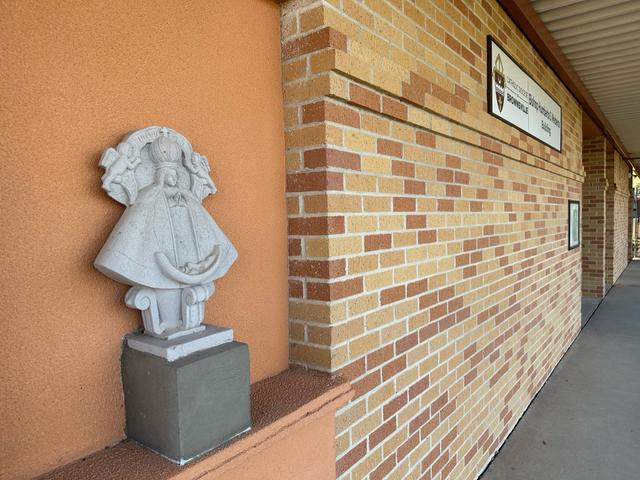
Facade of the Diocese of Brownsville Catholic Pastoral Center, where the Ofelia de los Santos interview took place.
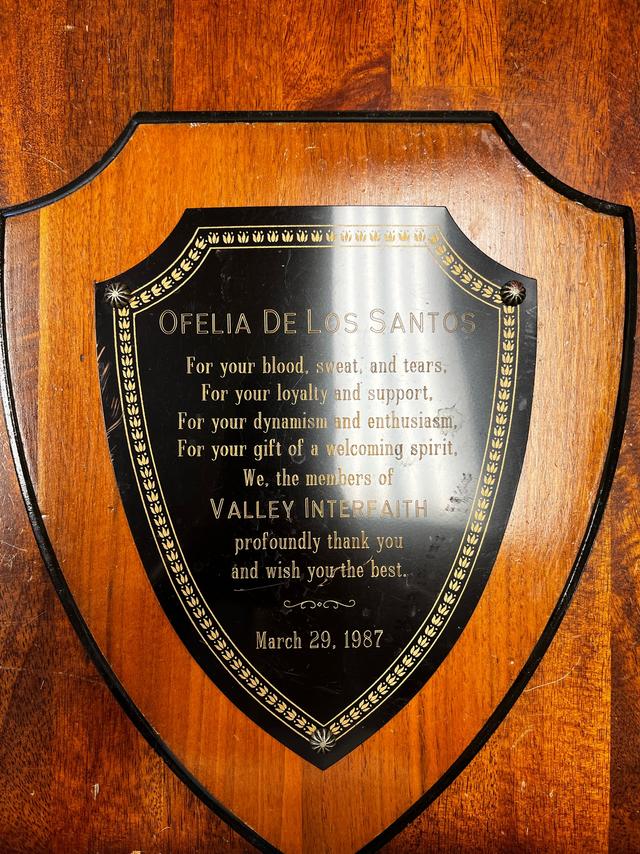
Valley Interfaith plaque thanking de los Santos for her service.
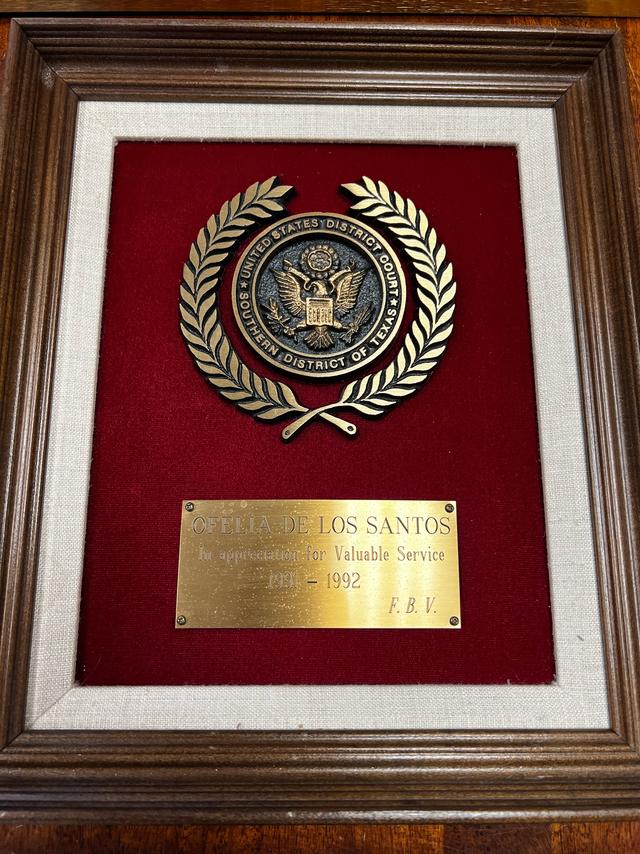
Plaque honoring Ofelia de los Santos “In appreciation for Valuable Service” from the U.S. District Court, Southern District of Texas, 1991-1992.
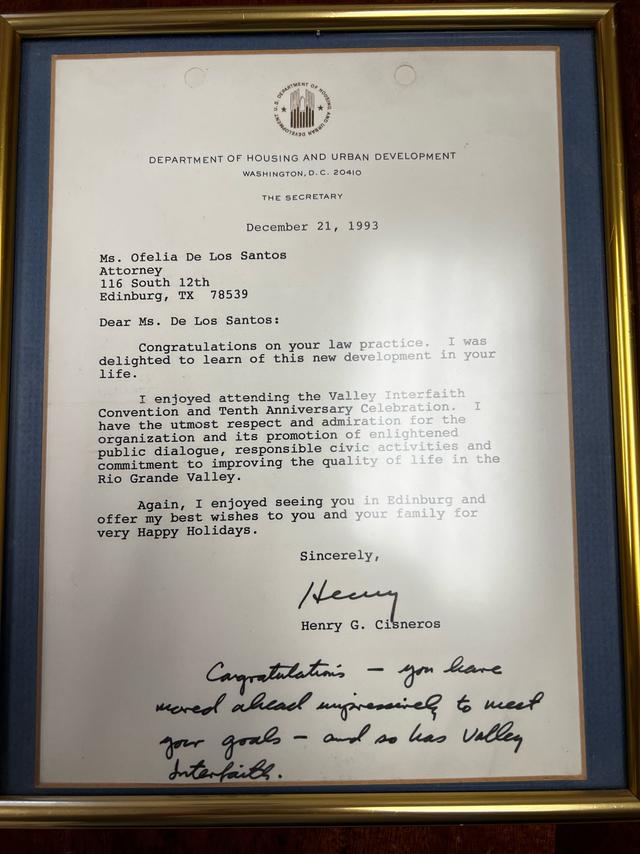
Letter to Ofelia de los Santos from Henry G. Cisneros, Secretary of Housing and Urban Development, 1993.
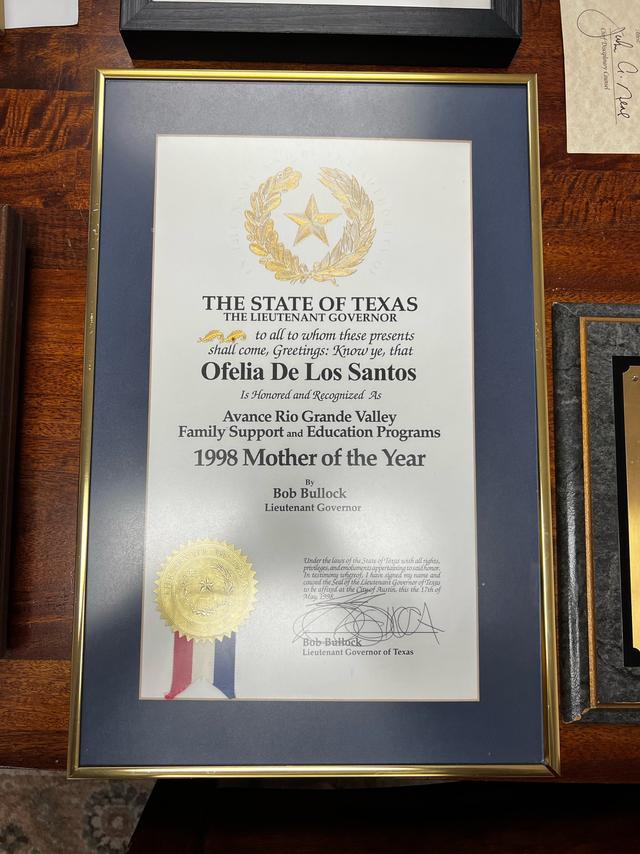
Ofelia de los Santos was recognized by Lieutenant Governor Bob Bullock as the Avance Rio Grande Valley Family Support and Educator Programs 1998 Mother of the Year.