Next page
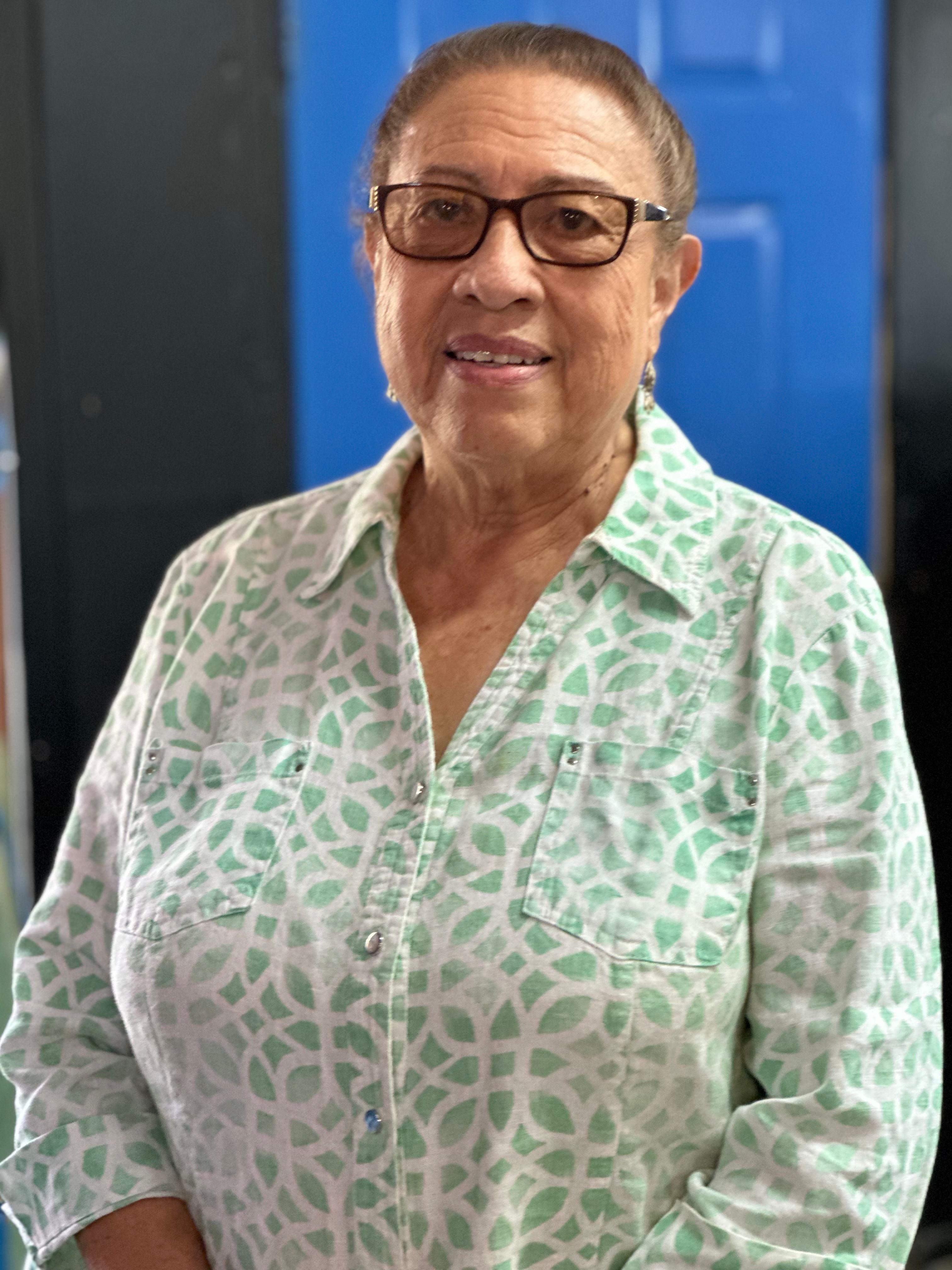
Juanita Valdez Cox
Organizations
La Union Del Pueblo Entero (LUPE)
Location
San Juan, Texas
Biography
Juanita Valdez Cox worked as a community organizer. She worked for Migrant Head Start, held prominent roles in the United Farm Workers Union and helped to found Proyecto Azteca in the Rio Grande Valley, an organization to help people find affordable housing. Valdez Cox was also one of the founding members of La Union Del Pueblo Entero (LUPE), an organization connected to the UFW that empowers farm workers and colonia residents to advocate for themselves and the issues that affect their lives. Valdez Cox’s organizing work was grounded by her personal experience as a migrant farm worker and as someone who grew up in colonias.
Audio Clips
Interviewed by Cristina Salinas on June 15, 2023 in San Juan, Texas
Valdez Cox discusses some of her community work, family background, and how she became involved in the farm worker union.
Juanita Valdez Cox: Yeah, yeah. Well, it was the union organizing. And I joined because my mom and dad became members. And I was working with Colonias del Valle, and I was the director of a Head Start center for welfare mothers and their children. But I learned that there, at Colonias del Valle, that welfare mothers, we couldn't... I didn't see a way there to break the cycle from getting welfare. And the state was always questioning the women, "Where's the husband? Do they come and...?" Because at that time, I think, the welfare was trying to get them off and always looking for a reason. And it was not. They gave them una miséria. It was like nothing to survive on, like $68 a month. So I saw a cycle that I didn't feel we were challenging at all.
Juanita Valdez Cox: And I just said... I remember my mom and dad saying, "Ay, no. Vamos a trabajar en el... We're going to..." is it okay to say in Spanish? "Vamos," because it was my mom and dad and they didn't speak any English. They said, "Vamos a trabajar al campo. Pero estamos organizando nos, y vamos a tener agua, y vamos a tener baños, y nos vamos a pagar bien, y no nos van a envenenar con los pesticides." They had this vision of how they wanted it to be. And we used to call it like, that was like their dream list of things they wanted to change. And I said, "How can the farm workers, who have absolutely no power, they just had a dream and a vision, who don't speak English, who don't have documents? And they're thinking they can do this, right?"
Juanita Valdez Cox: And so, what I would do is I would work at the Head Start, and then I would get off at 4:00 or 4:30, and it was in Pharr. So I would go through here, and so I would stop and volunteer with Rebecca. So volunteered an hour or two hours, and I started learning more and more about how... How what my mom and my dad and all the family, what we did was super important. That what we did to feed this world, nobody else was doing it except Mexicans. And I got to the point of where talking to Dolores, and Cesar, and Rebecca, and Zulema, a really strong woman, Zulema Hernandez, Maria Gomez. All of those ladies that I saw that now were starting to challenge, not only agribusiness, but they were starting to challenge the politicians. And so when I saw that, I said, "Hmm, I think I'm misusing my time here because I don't see a break in this. And so I need to stop working and volunteer full-time."
Valdez Cox speaks about the impact of LUPE, including wages and working conditions.
Cristina Salinas: Well, one question I had, although it seems almost impossible to answer, is how... Because it's so immense. But how do you think your work as an organizer has affected the community?
Juanita Valdez Cox: Oh dear Lord. Yes, yes. And it, it, yYeah. LUPE's work, before the UFW, major ways. Because now we have all the laws that protect farmworkers. We still have, need more, but we have the major ones. We have the toilets, the the clean water. We have the workers comp, we have the unemployment, we have the pesticide laws. So it's affected, thousands and thousands of people in the Valley. And I'm not saying just farmworkers. And when we win locally, the laws are for the whole state of Texas. So wherever there's farmworkers, wherever there's colonias, they're covered. But, the, um, so I think they see it as, they see the work of the UFW, and the membership, and the work of LUPE and the membership. Because it takes every single one of them. Somehow, each one has had a piece in the victories. And so... The laws, the respect, has changed. I remember my mom saying... We have students that come for spring breaks, from up north. This one was the University of Wisconsin. And one of the student... We place the students with families in the colonias. One of the students, Miguel Guevara, he's still a friend, stayed with my mom in the colonia in their tiny little house. And he wrote, he interviewed her, and he sent me a copy of this newspaper. It's like a school paper only. And the heading was "Angelita Valdez," my mom, "says ‘farmworkers have it made now.’" I about died. I said, "What is she thinking about? We have... We have... My mom..." I went home, I took the paper and I said, le dije, "Mom, mira lo que dice Miguel. Que tu le dijiste?" Y dijo, "Sí, mija. Si es cierto. Cuando yo estaba en la labor yo y tu papi no tenemos baños. Ahora tienen baños. Tenemos, tienen agua." Y luego dice: "Mijita, ahora hasta los demandan. Ttú andas en corte." Because in the early years our lawsuits were against local courts, because we were doing what they call secondary boycott. And they wanted to get us on that. Because we couldn't say, "Don't shop at H-E-B." But we had to because we didn't want the people to buy the grapes. So those are the lawsuits. And my mom was like, she was just, she just thought that we won big time. So now, only because we would win those little lawsuits that were only local ones, and because we would do picket lines, and because we demanded better pay on our... Because we would go in the fields and do work stoppages. Because the farmers... We were using a five gallon can, and they used to pay us $0.50. And then they went to a bigger can, a six gallon can. And they wanted to pay us, I think it was only like $0.80, saying that it was the same amount of onions. And we said, "Dang, you think we're really... But we're not. The five gallon has less onions, and you're stealing like a gallon of onions, or however many pounds it is." And we took them to court. And in front of the judge, I was one of the... I was... What do you call? The lead plaintiff for that one. But they, we took this five gallon can, and we took the six gallon can, and then a seven gallon can, because they kept going up, but the price wasn't going up. And the judge saw all of that. And we won, of course, right? Because he says, "You're telling me that you're paying the same for this and this and this? Or only $0.05 more? And you're stealing all of this extra pounds of onions? And at the store you still have to pay, I don't know how much?" So anyway, all of those things, I guess, were in my mom. And so she really thought we had it made already. [clapping hands, perhaps as if finished with a task.] “We’re done.” [Laughing] She is so funny. But in her perspective of how things were, of course. Dice “Y a mi nos pitaban a las seis de la mañana, a las cinco nos pitaban. Dois pitidos del troquero que nos llevaba a trabajar, si no salíamos pronto [snapping fingers rapidly] nos dejaron, y nos quedabamos sin trabajo dice ahora está muy diferente. So I forgave her for saying that. [Laughter] I mean, I understood it. Yeah. But so yes, that's the difference that our work, all of those that have contributed, we, we, I keep telling people, we stand on the shoulders of amazing heroes, and women heroes, because... There was a lot of sacrifice. We didn’t have, don't have martyrs here. We have martyrs in California that were killed for being with the union. They were killed for being on a picket line. We cannot forget that. And I have the video. It's called “Fighting for Our Lives.” And that's one thing I share with the staff that we hire. I share, I share them and I tell them, "You have to read this. You have to view this." And it's online and it shows... And I said, "Never forget who went through all of that to get us to the place that we're at. We have such a huge responsibility that we just, we have to be very careful, follow our philosophy of non-violence and our three core values where I'm here, whoever's here, whoever's director, whoever's member. Those three core values should never change. Never change." And they don't. And they've come in handy. We have respect. We have hope. And we have self-help. Those three. And it's those three goals. The self-help comes in real handy, although people criticize it. People that get federal funding, even if it's a nonprofit, criticize our membership fees because they say, "How can you charge the poorest of the poor?" Right? And we say, "Quien más lo va hacer?" We suffer it.
Digital Archive

Juanita Valdez Cox speaking at the banquet honoring her legacy, 2023.
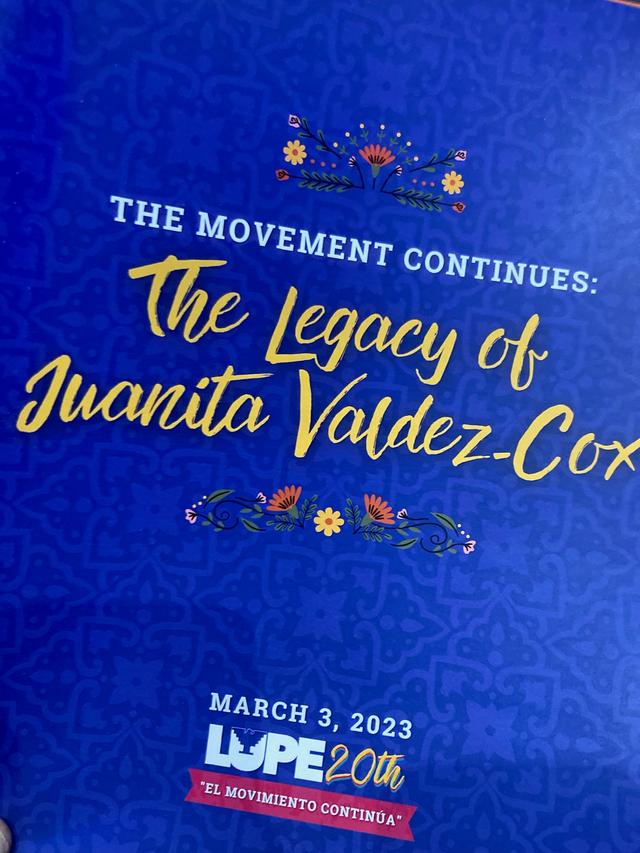
Program for the LUPE banquet honoring the legacy of Juanita Valdez Cox.
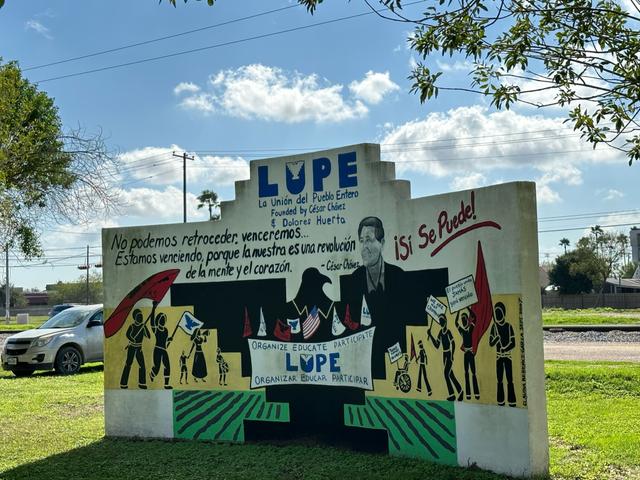
Mural outside the LUPE offices in San Juan, Texas.