Next page

Laura Dent
Organizations
Activate 48, CHISPA Arizona, Arizona for Abortion Access, City of Tucson, UFCW 99
Location
Tucson, Arizona
Biography
After graduating from the University of Arizona, Laura Dent began her political career as a union organizer. While working for the union, Dent became involved with Las Adelitas Arizona, a group founded to empower Latinas to become more fully enfranchised in the electoral process. She has worked for Tucson Mayor Regina Romero and then served as Executive Director of Chispa Arizona, lobbying for environmental justice. Dent went on to co-found Activate 48, a coalition of Arizona’s largest movement organizations—LUCHA, Mi Familia Vote, Our Voice Our Vote, and Chispa Arizona. In addition to lobbying work, this coalition worked to engage youth, Latinx, and BIPOC voters in Arizona while also building a leadership pipeline within those communities.
Audio Clips
Interviewed by Jennifer Nájera on May 8, 2024 in Tucson, Arizona
Dent talks about her involvement with las Adelitas and reflects on the fight for TUSD Ethnic Studies as a galvanizing event.
Laura Dent: Yeah. Oh my gosh, thank you for sharing that and just reflecting that back that really like that really is true. And I feel like I, I just felt like my community was always like my family and it felt like it got bigger and in this experience. So that was really interesting hearing you say that back. Um, I mean, I would say probably the most compelling and fulfilling would be when I started getting involved with Las Adelitas and, um, because that connected all of the pieces, like it was about like getting mujeres more engaged in the political process and like, seeing the flaws in, like our democratic system, but also caring enough to be involved in wanting to change that, because that is a big part of like my frame. Like there's a quote from Cesar Chavez that I think about a lot that is, um, there's no such thing as political systems, just or no perfect systems, just perfect participation. And I feel like I think about that a lot because I think there's room for like, all the kinds of activism. Right? Like the outside agitation, the like person that is like running for office and like all buttoned up. And then there's like the people in the middle, and I just feel like I totally appreciate every single like lane and, um, so I felt like Adelitas really brought that together for me because it was the community where honestly, like our meetings were just like happy hours and like hanging out and also like endorsing candidates and like raising money and, and supporting the people that we thought were going to do good things. So it was like a belief in the best of the system. It was like sisterhood and community. Um, and it was just like a more thoughtful, like, look at the world. So I would say that was like a really great. And that's actually where I met Michelle. Um, it was during the, um, ethnic studies fight at TUSD. So that's how we got connected together.
J. Najera: Okay. So that was I mean, that's a nice follow up question that you don't have to talk about that in particular, but I was just thinking if you were to reflect on your involvement with Las Adelitas, what do you think stands out to you as like one of the most, like salient political issues that you've addressed with them?
Laura Dent: Yeah, I mean, I feel like that was a big one just because it felt so important in the community. It felt so salient. It felt so like right here, but also in the middle of this, like big, um, storm.
J. Najera: Right.
Laura Dent: Um, so I think that one was important because we also were very like getting activated at that time, like a new kind of cohort of folks that were kind of around the same age. Um, yeah. So that I feel like was an important one. We were like going to board meetings and...
J. Najera: Like, just for the for posterity. I'm familiar with it because, you know, I teach ethnic studies and, you know, I remember it. But, you know, for posterity. Can you tell us a little bit about, like, what happened, like what was going on and why you decided you all decided to become involved?
Laura Dent: Yeah, yeah. So, um, we had a really racist, terrible superintendent who was, again, our superintendent, Tom Horne [laughs]. Um, and they were essentially trying to attack ethnic studies at TUSD and pull that back. And there was so many, um, folks that had appreciated and benefited from that program. And it was kind of like a very, um, esteemed program within the district. And, um...
J. Najera: Tell us about the program.
Laura Dent: Okay. So, um, Ethnic Studies basically focuses on well, actually, I, I was gonna say I never took the program myself, so I couldn't say like, exactly. But I think it's just about, like, uplifting seeing yourself in, like the history that is being taught in school, because everything was so anglocentric across the board that folks were not appreciating why the situation was what it was. They were having to go to college like me, who was in a point of privilege of being able to go to college, to become aware of, like, why are things the way they are? And who are the people from my own background that have made an impact, um, in my region, in this country on history. And why aren't we seeing those folks, you know, in the everyday, um, history being taught in schools? And so, um, you know, that had a focus not just on Latino youth, but on other, um, communities. And so the idea was that this was like a very compelling program that was really helping people and like, was a demonstrated benefit to community. And, um, there was also like this firestorm around it, like the district was like canceling the Chavez march and like, there was all kinds of stuff where it was like, would you ever do that? Like for an MLK March and like a majority black district, like, I don't think, but it it was like everybody was like afraid of talking about the issue. And so it felt like a huge firestorm in the community. And so I feel like everyone that was involved with Las Adelitas at the time was like engaged in that. But I also feel like there was so many currents of like organizing happening around that. And there was a lot of like stuff that we were not involved in too. But that was something that I think was a really galvanizing moment for Las Adelitas. And then I would also say like one time we went to a TUSD board meeting and we went to Casa Maria before, and we, um, I don't know if you guys ever saw but one of the school board members at the time, um, oh my gosh, I'm forgetting his name. Mike something. It was a very boring name. It was like Mike Brown or something. He was a board member, Mike Hicks, and he said that something so stupid and it came out, um, like, reported everywhere. It was something like, they're putting something in the burritos, like like the bean burritos. He said something about bean burritos, and that's what's radicalizing the kids. And that's why they're getting crazy. And they're taking Unidos is taking over the school board and oh my God, it was so ridiculous. It came out like on The Daily Show. It was like, so we went we hooked up with them, Casa Maria, and we went and like made burritos before the board meeting and we like, handed them out at the board meeting and like, we went and like gave them to the school board members on the dais. [laughter] And so it was so crazy. It was a really it was a really sad and insane time. But, um, yeah, it was definitely a very like hot moment for our community. And then also we, um, we started a PAC, which was really cool. So we didn't just, um, you know, organize around like other candidates that we thought would be good on our issues. We started to like, support the folks that we, um, wanted to see run. And so that felt like an exciting thing for me, too, as someone that I've now, you know, grown in my electoral politics career a lot more, um, that was a really that was a really good moment. And we started a scholarship, um, for Doctor Velez here, um, in honor of her. And, um. Yeah, that was a really. That was a really cool experience, too.
Dent reflects on her work in electoral politics and within the changing political terrain of Arizona.
J. Najera: How do you think that other people view the work that you, that you've done or that y'all have done through Las Adelitas?
Laura Dent: Oh my gosh, what a crazy question this is like so...[laughs] No, it's a great question. I'm just like, I just don't haven't thought about it like that. I mean, I don't know, I feel like there's people that might be like, this is this is like too establishment, like you're electing people into a really flawed system. And we should actually be like building skills amongst ourselves and like mutual aid networks. And so sometimes I feel like there's people that appreciate like that lane of progress and then there's people that might think that it's like not doing very much, that it's just like changing what the system looks like, but it continues to like do the same things. So I think it depends on who you ask. But I really have tried to like, choose opportunities that help me like build the skills to like, move my little like. The area around me, you know? Um, so I hope that people see that work and say like, okay, like, like, um, following, you know, my work for Regina, when she was on the council, I went to work for Chispa Arizona, which is a Latino organizing program that is couched within a big, you know, white environmental group. And I'm like, okay, I can't change everything about where I am, but like, I can change how we talk about the environment in this space and this community and that can make an impact. And, um, like right now I'm working for the Abortion Ballot Initiative as their political director. So I am translating flyers over here. I'm doing like the level one cultural competence around campaign conversations. And so I feel like even though I'm not upending, oh, I shouldn't put that in the recording, but I'm not like lighting anything on fire. I'm making the impact that I can like in the area that I can. And I hope that, you know, from outside people could see that and appreciate that.
J. Najera: Um, but I really appreciate how you're reflecting on your work. And that was actually the next question, which is like, you know, how do other people see you and how do you see yourself? And I think that, you know, that's that's an important part of it, like understanding, like, you know, um, what you have the passion for what you have that, you know, that, you know, you think is going to do X thing even if it's not going to upend or, you know, radically change overnight. You know, the system, it's going to move it in a particular direction. And, you know, there were specific issues that you're talking about, um, that, you know, I think illustrates your understanding of politics and what you can do right within, within where you are. And speaking of where you are, um, how do you think that your politics and political organizing has been shaped by being in Arizona? Like, what's the impact of Arizona on your political organizing?
Laura Dent: Yeah, I mean, it's like my only frame, right? Because I only have been here. Um, so I feel very, like rooted and grounded here. And I feel very blessed, like I'm from the Phoenix area. That's where my family still lives, and I live here, and I feel equally, like, comfortable in those communities and, like, spaces. And so that's like such a gift. I was thinking about it because I'm like, tomorrow morning at 5 a.m., I'm driving up to Phoenix. I'm gonna be there a few days, like, but it's like such a blessing to have that, like, um, so I don't know, I feel like, um, I feel very at home here. I feel like, very grounded here. And I feel like I have a good sense of, like, particularly like what's possible. Like, I like to think about like, like, for example, organizing in, um, this state for a long time has been like a defensive posture. We've been like fighting the 1070, fighting the sheriff Joe, fighting the ethnic studies ban. And now I'm like, what are we fighting for? Like, let's get ready for that chapter. And that for me is like what I like to spend time on and think about and is exciting. And that's actually something that Regina taught me. She I think she went on some trip and she came back and she was like, I saw this quote and I think about it all the time, and she's like, I'm going to tell you too. And it was like, um, it was like less time tearing down the old and like more time building up the new. And I try and do that as much as I can. And I keep that in mind, like a lot because we have that's our history is tearing down. We've been doing a lot of tearing down of bad things for, you know, our communities. And so I'm excited about that next piece.
Dent talks about the gendered contours of organizing and the support and encouragement she received from las Adelitas.
J. Najera: Um and then you talked a lot in this interview about you know, um, the women that raised you um, in your home, the women who co-raised you and your sorority and Las Adelitas, um, what I mean, how do you think being a woman has affected your organizing?
Laura Dent: Ah, I mean, it's just like, it's just. Well, I mean, it just feels like, hard to not think about because it's so much like who I am.[laughs] Um, I mean, I, I feel like I've been influenced by, like, all of those amazing figures in my life and have been, like, really, um, proud to be who I am, even when I feel sometimes like I'm like, in between worlds, like, um, I it feels like a really anchoring, like piece of my identity. And, um, also just even in the past years of, like, myself, you know, getting an abortion and, like, having a miscarriage and then becoming a mother, like so many things that just, um, I don't know, like, uh, is, like, unique to, like, our experience. Um, I don't know. I mean, I definitely think I'm, like, a better organizer because of it. I feel like, um, you just have, like, more, I think nurturing qualities, like understanding qualities, compassion, empathy. I think women are so socialized to, like, be aware of what's going on around us all the time that, like, you just can't help but like, read the situation before, like jumping in and making moves. Um, so I don't know. I mean, I just feel like definitely an asset in a lot of different ways. Um, and it just feels good to have that, like, community. I mean, like, I find myself building teams and organizations and I'm like, wow, look at all the women here. Like it just it I don't know, it feels good. Um, it feels good. Um, yeah. I don't know if I answered that very well, but...
J. Najera: NO, yeah, I think that's that's important. It sounds like you've really, um, maximized the communities of women that you've been in because sometimes the spaces are male dominated and... you know, so how do you navigate those spaces? It sounds like for you it's been to kind of having your community of women to support you and you go to for whatever you need.
Laura Dent: Yes. And I think trying to find like joy or find the spaces where like those nurturing, like those like home bases can be, um, because I don't like in the labour space, for example, that was very old and very like male dominated and like I was like, okay, this isn't the long time thing for me. Um, you know, some people really thrive and they're like, oh, I'm going to like prove this. And I was kind of more like, I'm going to find the the place that's right. So yeah.
Digital Archive

Logo for Las Adelitas.
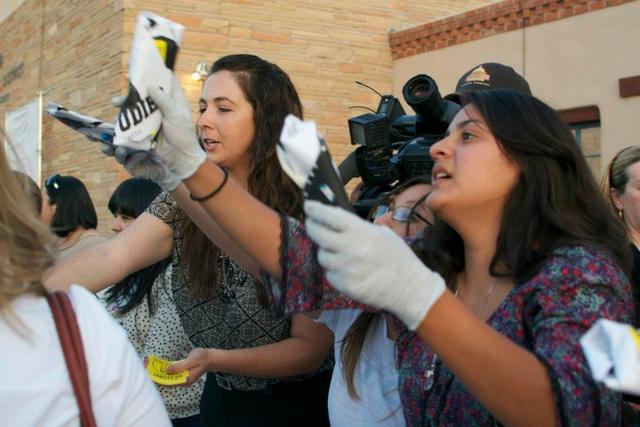
Dent taking part in “burrito tardeada” with Las Adelitas during the fight for TUSD Ethnic Ethnic Studies.
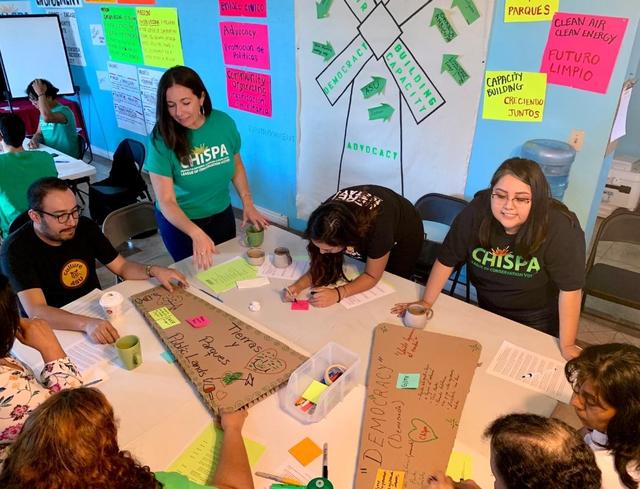
Dent working with other members of CHISPA Arizona on environmental organizing.
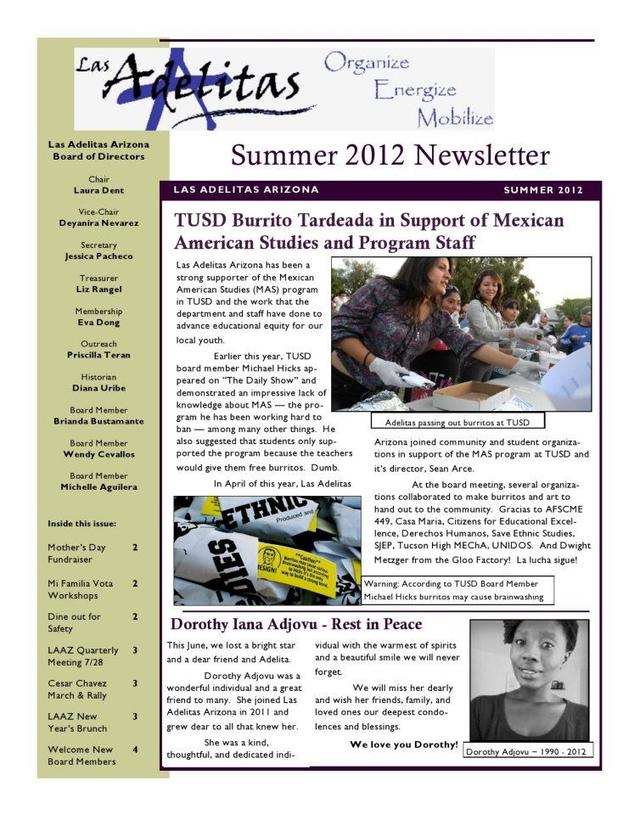
Las Adelitas 2012 newsletter featuring story about their “Burrito Tardeada”.
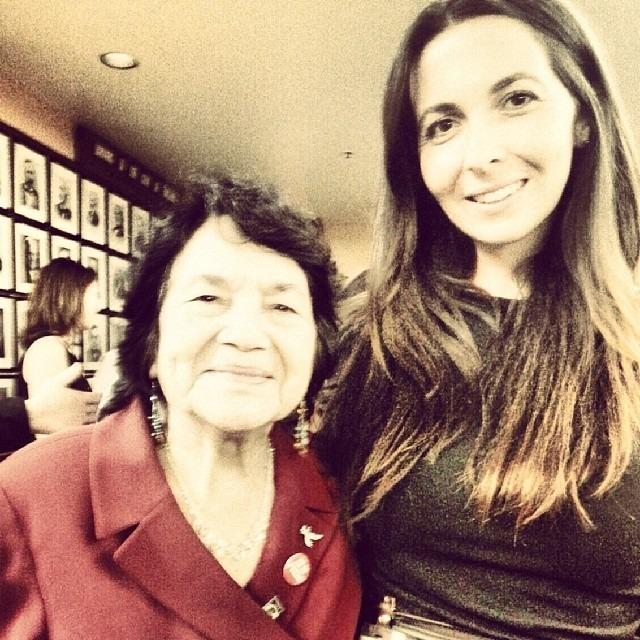
Dent with Dolores Huerta at the vote to establish a Cesar Chavez holiday at the City of Tucson.
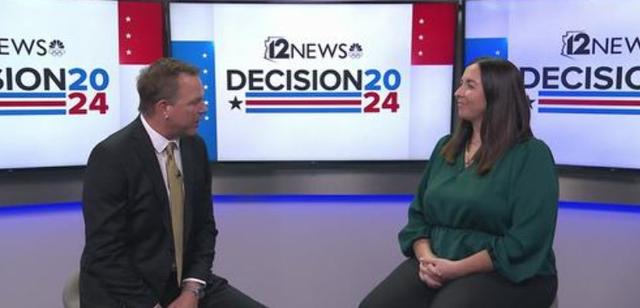
Dent explaining Proposition 139, Arizona for Abortion Access. This effort secured abortion rights for the people of Arizona in 2024. It was the largest citizen's initiative signature gathering effort in the history of the state.