Kat Rodriguez: Yeah. It was like a summer camp for farmworker kids and, or kids of farm workers, right? They weren't necessarily farmworkers. And they were mostly Mexican, Haitian, and Guatemalan, because that's what Immokalee... And I left, and then when I graduated college... So my dad ended up retiring from the military and then got a job at United Airlines. So I flew free until I was 26, which was another like, amazing, right? And my friend Tamara had stayed in Immokalee and she said, "Hey, I started working with this farmworker group. Would you want to come out and help us?" Because I was an art major. She's like, "They're planning this big march and maybe you could do some art for them." So I had an art degree and I was like, "Sure." So I went out there, and that's when I got involved with the Coalition of Immokalee Workers. And I ended up making a... She's a ten-foot Statue of Liberty, but she's got brown skin and she's holding a tomato and a cubeta. Then I had her on a pedestal that had “I, Too, Sing America,” or “I, Too, Am America” from Langston Hughes' poem that I loved.
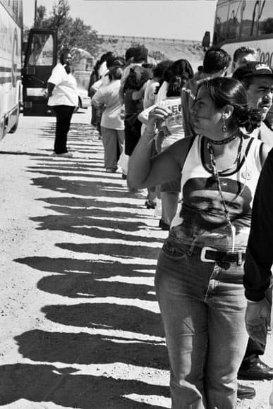
And we marched with her, from Fort Myers to Orlando, to the Florida Fruit and Vegetable Association. It was a 233-mile march. I had never been on a march before. I had not been involved with activism. This was my first. And the CIW is pop-education style. Their meetings are in Spanish and Creole. I didn't speak great Spanish at that time. I learned they do everything pop-education style. I learned that my place was a place of privilege and I was there to serve. You know, "You're driving because you have a driver's license," and, "You're running to get water," and the decisions were made by the workers. And it was just understood that that's how that worked. Because they have the most at stake. And so they were really my... I guess my training ground into activism. And that's how I think of activism, and the way that I feel is the most sustainable is collective organizing. So that's how I learned about it. And went on this march, and we marched 15 to 18 miles a day, and I got to march when I wasn't having to drive the massive flatbed truck, because I knew how to drive a stick. It was amazing. It was life changing.
We got to Orlando and the Florida Fruit and Vegetable Association originally said, "Oh, we're going to greet the workers and we're going to give them cookies and juice."And we arrived, and there was hundreds of people, and they shuttered their doors and locked the doors. And we had been on a lane of traffic the whole time. So this flatbed truck had her on the back. Then they took that away and they put her up on the flatbed. And then we got into Orlando and the cops just turned really hostile. And they were like, "You cannot bring that truck, you can't have a lane. You're going to have to walk on the sidewalk." And so I was really sad. But then the workers were like, "We're not leaving her. Like we're not leaving her." I called her my niña because I was like, there's literally like my blood in her and my sweat like I've been... She's chicken wire and plaster. And so they were like, "We're not leaving her." And they took her off her pedestal, and they carried her on their backs for the last six miles. I have these... So it was actually worse for the... Because there's this picture of these farm workers under the weight of Lady Liberty. So it was just this amazing... So talk about a way to be introduced to the movement. It was incredible.